Showing posts with label Left-wing. Show all posts

Thursday, August 23, 2018

In which I answer Jordan Peterson's question

I have been following Jordan Peterson, the Canadian psychologist who has achieved considerable recognition for his blend of philosophy and self-help advice, for a couple of years. I like his message of individual responsibility and his rejection of identity politics and the post-modernist doctrine that has infected so many of our institutions. I don't agree with everything he has to say - for example I think his almost exclusive reliance on religious texts to exemplify his philosophy neglects the equally great and relevant sources of the Western Enlightenment (such as the Ancient Greek philosophers*) - but he makes us think as few modern intellectuals do and for that I am grateful.

Peterson points out that political views can be defined in psychological terms. Conservatives tend to be higher in trait conscientious, whereas progressives are higher in trait openness. He says societies need both - conservatives keep the barbarians from the gates, progressives break down the entrenched hierarchies to ensure everyone has an opportunity to thrive. If conservatives dominate too much, society becomes stagnant; too much progressivism and we end up with chaos.

Peterson has posed an important question to commentators on the political left, which I will attempt to address in this post: at what point do we judge that the left-wing has gone too far? In other words, what defines the "extreme left"? There is a widespread consensus about the point at which the right-wing is considered extreme - Peterson defines this as "claims of racial difference that support the notion of superiority". The evidence that the right went too far with this belief is the death and catastrophe caused by the rise of Nazism in Germany, Fascism in Italy and imperialism in Japan. But the evidence of the excesses of the left is just as profound - the destruction and misery wrought by the Marxist regimes in the Soviet bloc, Maoist China and Pol Pot's Cambodia produced an even greater number of human deaths.

However, it is not mere adherence to hard line Marxism that defines the extreme left. The Bolivarian Socialism practiced in Venezuela today is closer, at least philosophically, to Western democratic socialism than Stalinism and yet it has produced misery on a scale that is presently matched only by North Korea or Syria. Besides, it is acceptable - cool even - to publicly proclaim oneself as a Communist as a young woman did recently on Piers Morgan's television show. Imagine the reaction if she had said, "I'm a Nazi, you idiot!"

Peterson chastises the left for its reliance on identity politics with its ever-increasing list of victim groups, ever-expanding definition of oppression, and scapegoating of a very specific group (white, middle-aged males) as the perpetrators of all that is wrong with the world. He rightly points out that if the left wants to play the identity politics game by claiming their preferred groups always lose, why wouldn't the right play the game with their preferred group to win? Which is, of course, exactly what the Nazis did and white supremacists are still doing today.

When he ventures an answer to his own question, Peterson says it is equality of outcome, or equity, that defines leftist extremism. This isn't a bad answer but in my view it is unsatisfactory. Almost everyone in Liechtenstein is a millionaire - is that a bad thing? We must consider the means as well as the ends in defining what is good and bad.

The essence of Peterson's philosophy is that we should conduct ourselves in life as if we are the noble person we aspire to be. In other words, to act as if the means are the end. The corollary of this is that you can't achieve a noble goal via an ignoble path, at least not without corrupting the goal for which you are striving. Most people on the political left have a noble aim - the greatest good for the greatest number of people. The moderate leftists believe that we shouldn't sacrifice the dignity of the individual to achieve the collective good, and they demonstrate this by fighting for individual rights (such as freedom of expression) just as vehemently as they fight for their desired group outcomes. The not-so-moderates are willing to sacrifice the individual to achieve their desired ends.

I believe it is not equity or identity that is the root of the evil but the use of force. The left (and the right) goes too far when it is prepared to put the individual to the sword in the interests of the collective. Peterson understood this when he stood up to the enforced use of gender-neutral pronouns. It was precisely the use of force to compel speech that he rightly objected to. Doing nothing was not an option - the state was going to censure him, fine him and (ultimately) arrest him if he didn't do what they wanted.

My politics is defined by my adherence to the non-aggression principle (NAP), which states that humans beings should not initiate force in their dealings with other human beings. Moderate leftists like the idea of the NAP - it aligns with their "live and let live" principles - but it poses a dilemma for them. How can you marshall the resources of society to achieve collective outcomes without the use of force? That is where free markets come in. We have proved in the modern era that individuals acting in their own interests, without the use of force, can produce unprecedented collective benefits. Yes, I concede that capitalism is not perfect, but it is the only political-economic system that at least allows for the absence of force.

Not-so-moderate leftists don't see any conflict between the means and the ends. They regard the use of force as a feature, not a bug, of Marxist philosophy. And they are right to do so - Marx made no bones about the need for violent revolution to achieve his utopia. I doubt that he was serious about the withering of the dictatorship that was meant to happen after the revolution - I think he just said that so as not to frighten the European intelligentsia that was the main target market for his political philosophy.

So the answer to Peterson's question is that the point at which the left goes too far is the point at which it is prepared to initiate violence against the individual in pursuit of the interests of the collective. Unfortunately this means leftist philosophy is a Catch-22 - you can't reach collective heaven without creating hell, and hell isn't a place that you can just close down when you think you're done with it. The extreme right, of course, has no such qualms - they are only interested in getting their own kind into heaven and are happy for the rest of the world to burn.

I was hoping to avoid religion in this article but that was probably a vain hope when discussing Jordan Peterson, so I might as well continue with it in my conclusion. Many leftists are Christians and there are strong historical links between socialism and modern Christian (particularly Protestant) churches. But Jesus was first and foremost a pacifist and he believed in a separation between the state and the spiritual ("Render unto Caesar..."). Of course, there came a point when the Christian church and the state were joined at the hip and both justified the use of violence in the name of God, and this was when Christianity became tyrannical. Fortunately the Western world has largely left that behind and these days we abhor the use of violence to achieve religious ends. I hope in the future we will have the same attitude towards the achievement of political ends.

* Interestingly, since I wrote this post, Quillette has published an article elaborating on the same criticism: https://quillette.com/2018/08/23/progress-and-polytheism-could-an-ethical-west-exist-without-christianity/

Friday, July 21, 2017

You wouldn't recognise the working class if you fell over it

I find it laughable that left-wing commentators still insist that they speak on behalf of the 'working class'. Their rhetoric is filled with disparaging references to the 'upper class' and the 'bosses' as if they are quoting from one of Karl Marx's works and as if they themselves weren't part of the groups they are maligning. The reality is they don't speak on behalf on the working class at all and wouldn't recognise members of that group if they fell over them. The popularity of Brexit and Donald Trump, so despised by the left, with lower-income working people should be ample proof that the left-wing is completely out of touch with what such people really think.

The left-wing does not represent working people any longer. The biggest supporters of so-called progressive ideals today come from the highest income earners rather than those at the other end of the scale. They are the politicians, public servants, academics and those in the private sector that are most dependent on the government for their incomes, who typically earn far above average incomes and who have little exposure to the working class on whose behalf they purport to speak. Welfare beneficiaries support big-government left-wing parties for obvious reasons, but genuine working class people - those who continue to provide for themselves in spite of the disincentives to work of the welfare state - are now as likely to support right-of-centre parties and candidates. This is because it is the latter that speaks to their disaffection with the loss of high-paid blue collar jobs, the rising cost of living, and the perceived economic threat from immigration.

The problem for left-wingers is they have no self-awareness so they tend to believe their own propaganda. They claim their political interests are aligned with those of the underclass but for this to be believable they have to convince us, and themselves, that there is still a traditional class system. It is true that there is an elite in Western countries today but it does not comprise the same people who dominated the upper echelons of government and other institutions up until the middle of the 20th Century. Today's elite is technocratic and bureaucratic rather than aristocratic and largely comprises the left-wingers themselves. Like the elite of yesteryear, they arrogantly assume they know what is best for their subjects and speak disparagingly of those over whom they believe they should rule. The modern version of Marie Antoinette's apocryphal, "Let them eat cake", is surely Hillary Clinton's "deplorables" comment. And the consequences for the utterer were similar.

Thursday, May 4, 2017

Left-wing view of democracy should not surprise

Yesterday, I participated in an interesting discussion on Chris Trotter's Bowalley Road blog about the health of democracy in the Western world. Chris, who I am sure wouldn't object to being described as an old leftie, wrote in response to a New Zealand Herald columnist who was bemoaning the death of democracy, as indicated by the election of Donald Trump in America, Theresa May in Britain and Bill English here in New Zealand.

I said that democracy was doing just fine and made the point that left-wingers always blame the state of democracy - or some other factor such as 'deplorables', Russian hackers or 'fake news' - for their failures rather than themselves and their philosophy. The fellow who responded to my point said that 'democracy has a bad time whenever bad guys get elected.'

This comment speaks volumes about the real view of many on the left about democracy. They believe, like President Recep Erdoğan of Turkey, that 'democracy is like a train, you get off once you have reached your destination.' In other words, democracy should be allowed to produce only one result - victory for their 'good guy'.

Democracy is by definition a pluralistic system and if there can be only one result, then that is not democracy but a dictatorship. Of course, the worst left-wing dictatorships have always styled themselves in Orwellian fashion as 'democratic republics', so perhaps we should not be surprised when left-wingers in Western democracies reveal that this is also their interpretation of what it means to be a democracy.

Someone in America once said, 'scratch a liberal (in American terms a left-winger) and a fascist bleeds'. So true.

Wednesday, January 25, 2017

Trump and the Left-Right Divide

Recently I completed a survey that evaluated the political views of New Zealanders and matched them to the policies of the main political parties. My views, perhaps unsurprisingly, most closely matched those of the (relatively) libertarian ACT Party, but it was the left-leaning, environmentalist Green Party that was my second closest match. I wasn't surprised at the latter as the Greens are socially liberal - supporting decriminalisation of soft drugs, equal standing before the law for gay couples and greater protection for civil rights - all of which are in line with my own views.

This got me thinking about the traditional left-right divide, a dichotomy that always frustrates me because I don't see myself as belonging to either side. Too often people like me with classical liberal views are characterised as right-wing along with others who hold quite statist and authoritarian views, such as Donald Trump.

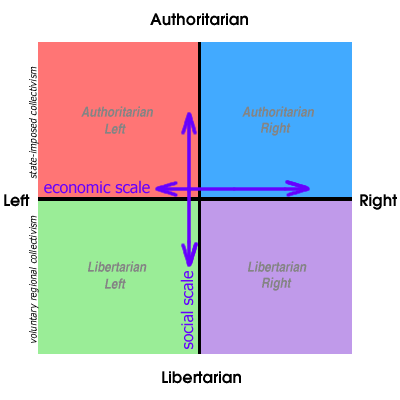
There have been attempts to build more complex models such as the Political Compass, which has two dimensions with an economic and a social scale, as shown below.


This matrix allows a more detailed representation of political views but in my view it still does not provide an completely accurate picture. For example, it puts Hitler at the very top of the social scale but in the middle of the economic scale, and Stalin on very left of the economic scale, whereas I see their Fascist and Communist philosophies as very similar in every respect. It is one of the great myths about Fascism that it allowed economic freedom. In Nazi Germany and Mussolini's Italy, private companies were permitted to operate only under the strict control of the state and only then when they served the state's interests. Thus, many companies were forced to move production capacity to armaments manufacture rather than the products their owners would have preferred to produce. That is hardly economic freedom.

The chart below shows the positions of various historical figures.
So where do I fit on the matrix? Here is my position:


What about Donald Trump? The Political Compass website assessed the US presidential election candidates as follows:

Trump is quite far up the social axis towards authoritarianism, as is to be expected, but perhaps not as far to the left of the economic scale as I would have thought. This is probably due to a bias in the framing of the questions that equates crony capitalism with economic freedom, which is essentially the same problem that places Hitler in the middle of the economic axis, as noted above. The closest of the historical figures on the chart to Trump is Margaret Thatcher, although I think Thatcher was significantly more economically liberal (and perhaps more socially conservative) than Trump.

Trump is the man the left-wing loves to hate but in reality his policies have far more in common with the views of those who describe themselves as 'lefties' than they do with my philosophical beliefs. It is ironic that Trump's first significant executive order was to withdraw from the Trans-Pacific Partnership agreement, an action he completed as people were marching in protest against his election. Many of those who were protesting were undoubtedly the same people who had protested against the TPP. It is revealing that in the above chart Hillary Clinton is further to the right economically than Trump - again something many of her supporters would be surprised to see.

I think there is really only one axis when it comes to political beliefs - authoritarian vs. liberal - and anyone who claims they can be at one end of the axis on social matters and the other end on economic matters is deluding themselves. The economist Milton Friedman (whose views are shown in the second chart above) said that a country could have economic freedom without political freedom, but not the reverse. I disagree - freedom is freedom, and economic freedom without social or political freedom, or vice-versa, is contradictory and unsustainable - but that is probably a subject for another blog post.

Tuesday, March 29, 2016

Political Opinion Masquerading as News

Over the Easter break I made the mistake of listening to a news bulletin on Radio New Zealand. I always find listening to the news or current affairs on RNZ to be a mistake because what RNZ thinks is news, and what I think is news, are two very different things. The first three or four articles in the bulletin followed the same formula - the presentation of what is in fact a political viewpoint as a news story, interviews with sympathetic so-called experts without resort to any facts or objective assessment and, inevitably, a call for the government to spend more money to address the issue.

An example was an article on the number of homeless people on the streets of Auckland. The article presented this issue as if it was something new and pressing, but it contained no facts about whether the number of homeless people in Auckland is actually increasing, who these people typically are, and what might be the reasons for their homelessness and therefore the most appropriate solutions to the problem. Instead, the purpose of the report was revealed as a call for the government to build more state houses.

Auckland does, in fact, have a housing shortage but the reason people are sleeping rough on the streets may have little to do with the availability of housing or even much to do with the amount of financial or accommodation assistance that is available to them. Often, in my experience, such people choose to sleep rough for various reasons unrelated to pure financial issues and their numbers tend to peak in the summer months and go down in winter due to the obvious climatic factors.

Much of what passes for news in New Zealand, particularly from our state-owned media, is of this nature. It is not news at all but rather a thinly-disguised presentation of the station's editorial position, which is invariably left wing, under the guise of a news story. 

There is something unhealthy and inevitable about a state-funded media organisation calling for more government spending, but it becomes a particularly pernicious practice when it replaces that organisation’s proper function, which has become the case in regards to RNZ. It is a gross abuse of taxpayers funds.

I reiterate the call I have made previously that there is no point in the New Zealand taxpayer owning an organization like RNZ, particularly when it seems to regard its role as being the promotion of a particular political point of view. Radio New Zealand should be sold, preferably to Rupert Murdoch.

Monday, December 7, 2015

Reaction to San Bernadino Shooting is Revealing

The reaction to the mass shooting in San Bernadino, California, last week was almost as horrifying as the killing spree itself. I learned about the incident as was I was talking to a senior civil servant I have been working with recently and he immediately muttered something about, "right-wing gun nuts." This guy was, like most senior civil servants, an avowed leftie and it was obviously wishful thinking on his behalf because even at that stage the facts indicated that this was no run-of-the-mill (if one could use that expression in this context) mass killing. It was known there were at least three heavily armed offenders dressed in body armour and driving a large SUV, facts that suggested it was an organised, military-style attack. I responded by betting him it was Islamic terrorism and it gives me no pleasure to have been proven right in the days since the attack.

The comments of this civil servant were echoed throughout the left-wing media here and in the United States and the anti-gun lobby, including President Obama, jumped in with calls for stricter gun laws. Of course, calling for a ban on gun ownership in response to a case like this is about as pathetic as calling for aircraft to be banned in the wake of 9/11. Yesterday Obama changed tack and made a speech in which he conceded this attack really was terrorism.

The response of left-wing commentators and politicians to this incident says a lot about their moral ambivalence. In the leftist view, a mass killing by a right-wing nut job is bad, but a similar incident by a Muslim in the name of his faith is not so bad. We see this double standard all the time - it is bad for Israeli soliders to respond to rocket attacks on their cities by targeting Hamas strongholds in Gaza but okay for Obama to order drone strikes on civilian targets in Waziristan. In their view it is not the act itself or the degree of innocence of the victims that makes mass killing moral or immoral - it is the political views of the perpetrators.

We should not be surprised by this moral ambivalence because that is at the heart of the collectivist philosophy. The rights of the individual are subservient to the will of the majority and therefore the idea of any absolute human rights is alien to them. Even the right to life is relative - leftist lives are worthy, but right-wing nut jobs do not deserve to live.

Monday, September 7, 2015

All immigrants need is life, liberty and the opportunity to pursue happiness

In recent days we have seen a lot of hand-wringing, particularly from the Western liberal-left media, about the influx of refugees into Europe from Syria. On the one hand they say we must "do something", on the other it is clear they don't like the idea of letting such people into their own countries. In fact, modern so-called liberals tend not to be liberal at all when it comes to immigration. This is not surprising because immigration poses a dilemma for Western democratic socialism.

Marx's ideal of international socialist solidarity has morphed in Western countries into a highly nationalistic socialism that is all about preserving the privilege and exclusivity of the domestic welfare state. Western socialists pretend to be concerned with the victims of repression in countries like Syria but actually they see such people as a threat to their increasingly fragile world. They realise that each immigrant is a challenge to the carefully constructed power balance in Western societies between the increasing unproductive majority of the population and the productive minority who support them. Unproductive immigrants add to the burden on a base of taxpayers already staggering under the weight of welfare demands, and productive immigrants merely serve to show how unnecessary and counterproductive much of the modern welfare state really is.

The reason I am truly liberal on immigration is because I am a humanist. Socialists try to paint themselves as humanists, but a true humanist is someone who values human potential. A true humanist sees immigrants for their opportunity to add to our society as producers, not as victims who only ever consume limited resources.

A guest post by Alex Nowraseth from the Cato Institute on Not PC's blog proposes building a wall around the welfare system to exclude immigrants. Personally, I think this is morally indefensible. Are immigrants merely slaves to the indolent native-born? The only moral solution is to reduce, or better abolish, the welfare state so that the productive of society, whether immigrants or native-born, are unshackled to pursue their own interests.

The Statue of Liberty was inscribed with the famous words from Emma Lazarus' poem "Give me your tired, your poor, your huddled masses yearning to breathe free" and America lived up to this exhortation by absorbing more than 30 million immigrants between 1850 and 1920. It was only a comparatively free and capitalist society like the United States was during that period that could afford to absorb so many from those huddled masses. Americans understood back then that immigrants bring with them in their minds and bodies the opportunities they create. They don't need to be given anything other than life, liberty and the opportunity to pursue their own happiness.

Thursday, July 30, 2015

The question all lefties should answer

A friend of mine, with whom I don't usually discuss politics, recently explained her view on some current issue by saying, "Of course, I'm a leftie."

There were a couple of things I felt like saying in response. The first was to express a complete lack of surprise. She is an attractive, educated woman with a nice house, a husband who makes plenty of money and a beautiful young family - what else would such a self-satisfied creature be but a leftie? The second was to question her moral compass, given that lefties were responsible for far more murders of their political opponents than 'righties' over the course of the last hundred years. In fairness to my friend, I assumed her views were more a product of intellectual laziness than immorality and I didn't say any of these things to her because I didn't want to spoil what was a very pleasant lunch date at an outdoor café on a sunny afternoon.

The moral challenge I felt like posing to my leftie friend is similar to that posed by American historian Eugene Genovese in his essay, The Question. Genovese was a notorious Marxist who changed his views later in life because he reflexively posed the question that is the subject of his essay - the same question that was asked of Germans in respect of the Holocaust after World War II - "What did you know, and when did you know it?" Genovese, perhaps uniquely amongst left-wingers, poses the question to Marxists and their fellow-travellers, "democratic socialists" and "radical democrats" (and he applies the parentheses to those terms), in respect of the tens or hundreds of millions of people who have been killed by left-wing regimes that Western lefties have supported. I raised a similar question in my blog post from Cambodia earlier this year on Western support for Pol Pot.

Genovese challenges the inevitable excuse of the left-wing apologists for genocidal regimes by saying, "the horrors did not arise from perversions of radical ideology but from the ideology itself." The excuse that every instance of radical socialism in practice is not a true manifestation of Marx's philosophy is what I find to be the most pathetic and dishonest of all of the left's multitudinous examples of self-delusion. Genocide is not an aberration of Marxism, it is the sine qua non of it.

I recall having an argument with my political science tutor at university, a proud Marxist (which, again, is hardly a surprise) who stressed Marx's theory that the dictatorship of the proletariat would dissolve upon achievement of the egalitarian aims of the revolution. In other words, the existence of Marxism was not dependent on a dictatorial state other than in its early stages. I pointed out the obvious logical inconsistency with the theory - that a system that requires violent repression of human rights during its gestation cannot endure in the absence of that violent repression. Once the state has been dissolved, there is nothing to enforce the artificially-constructed egalitarianism of Marxist ideals.

Human rights are, by definition, about allowing humans to pursue their own self-interest, i.e. what the American founding fathers called "the pursuit of happiness", and socialism is about subjugating self-interest in the interests of the collective. So, logically, the only way of maintaining the socialist nirvana is to retain the necessarily violent suppression of human rights that imposed it in the first place. I also pointed out to my tutor the logical inconsistency that any system that is reliant on an elite who have the guns can hardly be called egalitarian. I don't think he had ever had anyone challenge his beliefs in such a manner as he seemed quite crushed by the encounter with logic.

I guess it comes down to whether you think you can separate the means from the ends, and this is the moral problem I have always had with Marxist philosophy. I believe that any system that requires its adherents to justify murder in pursuit of its goals cannot be moral. She would be outraged were I to point it out, but there is a terrible moral equivalence between genocidal maniacs like Stalin and my friend sipping her latte in a café on a sunny day. They differ only in the extent to which they would stomach the logical outcomes of their beliefs.

[A hat-tip to Tom Woods who brought my attention to Genovese's essay in a recent episode of his excellent podcast.]

Thursday, January 29, 2015

Eleanor Catton's views are tediously predictable

There has been a great deal of comment here in New Zealand about Mann-Booker Prize-winning author Eleanor Catton's comments to an Indian literary festival. No country likes its prominent citizens being disloyal and New Zealanders seem to be particularly sensitive about this sort of thing. Personally, I think it is a bit of a storm in teacup and I have to say I agree with some of her comments, particularly the bit about the strange belief New Zealanders had (at least up until recent years) that their writers were less great than writers from Britain and America. I suppose the only part of her comments that is disappointing to me is her statement about the current middle-of-the-road John Key-led government being "neo-liberal, profit-obsessed, very shallow, very money-hungry politicians who do not care about culture."

Anyone who regularly reads my blog will know that I am no fan or defender of the Key Government and it is not that Catton is criticising the government that disappoints me. It is rather that her left-wing views are so damned predictable. Writers, actors, musicians and others in the so-called creative sector are tediously conformist in their politics and, in my view, invariably hypocritical and disingenuous. I can only interpret Catton's comment about the government not caring about culture as meaning it does not care enough about her cultural output to bestow large sums of money on her personally.

Actually, there are a few exceptions to the tedious political conformity of the entertainment sector and one that comes to mind is British singer Adele. Her comments several years ago on high taxes and the National Health Service were a breath of fresh air. Likewise, James Blunt's recent response to a senior British Labour MP's comments about Blunt's 'privileged background' were brilliantly apt. I am sure there are many more singers, writers and actors who don't share the left-wing faith of many of their peers. It is a pity more of them don't have the courage to say come out publicly and say so. Certainly, there is nothing brave in Eleanor Catton spouting her entirely predictable, run-of-the-mill, bien pensant views.

Wednesday, January 21, 2015

Welcome to Reality, Lefties

I've been slow to start my blog posts for 2015, in part because I have been enjoying a wonderful New Zealand summer holiday with a large number of international family and friends, and partly because I felt that any further comment on the only topic worth writing about - the Islamic terror attacks in Paris - was redundant in view of the screeds that have been written on that subject already. But over the weekend a second, less dramatic but not unrelated international news report got me thinking. That second event was the massive drop in the value of the Euro against the Swiss Franc, occasioned by the decision of the Swiss central bank to stop propping up the Euro through massive buying of the common currency. Now what, you might wonder, do these two events have in common? The answer is that they are both massive reality checks for, and repudiation of, the conventional left-wing viewpoint of world affairs.

For years the political left-wing has been promoting the idea of cultural relativism, that is the view that there is social, scientific, economic or moral equivalence between all cultures. This view says that Western, liberal, democratic, capitalist societies are not in any way better than the most primitive, brutal and oppressive societies. Alongside cultural relativism, the left-wing also favours the notion of group identity, that is that we should not be judged as individuals but rather as a member of a culture, be it race, sex, religion or whatever group they (i.e. those doing the judging) choose to identify us with. Identity politics demarcates us into favoured and unfavoured groups, usually determined by our supposed victimhood. Therefore, African-Americans are favoured because they were once slaves and are still arguably the subject of some discrimination, while European-Americans are unfavoured because they aren't identified as victims (various European genocides notwithstanding). Likewise, women are good, men bad; gays are good, 'straights' bad; and, in the latest cause du jour, Muslims are good, Christians bad.

I'm sure you can already see a contradiction between these two ideas that are held as articles of faith by the left-wing. If there is equivalence between all cultures then how can it make sense to judge people on the basis of their culture?

The shootings in Paris, as dreadful as they were, couldn't have presented the contradictions of left-wing dogma better than if they had been staged to do so. In the Charlie Hebdo shootings, a group of left-wing journalists (the high priests of their social justice religion) were shot for exercising their right to satirize Islam. Cultural relativism came face-to-face with identity group politics and it was amusing (no, actually appalling) watching the contortions of politicians such as Barack Obama and Francois Hollande as they tried to steer a line between condemning the attacks whilst avoiding assigning any blame to the religion with which the perpetrators identified. If there was any doubt about the explicit aims of those responsible, it was removed in the second attack on a Jewish grocery store, a shocking in-your-face repudiation of all the weasel words about the Charlie Hebdo attack that had issued from Western politicians.

Which brings me to the collapse of the value of the Euro against the Swiss Franc. The political left-wing and economists who sympathise with their aims believe in the boundless benevolent power of the state when it comes to economic matters. They believe they can magic money out of thin air, so long as that money is used for government spending that is directed towards 'worthy' consumption. Of course, history teaches us that states cannot just print money without it eventually debasing the value of the currency (i.e. causing inflation). The European Union and the United States have both been making new money in huge quantities to fund their profligate spending. They have got away with it to date because, like the emperor's minions, everyone has turned a blind eye to their monetary nakedness. In the case of the Europeans, the Swiss had agreed to support this economic farce by pretending the Euro continued to maintain its value against their franc. What the Swiss National Bank did last week was to abandon the pretence and the Euro went down by more than 30% in a day. The Swiss did what they did for a very obvious reason - they couldn't afford to keep buying Euros to maintain its value (Switzerland's reserves of Euros amounted to the equivalent of 70% of its GDP prior to the fall). What has just happened to the Euro is a demonstration of what is going to happen to the US Dollar once the world realises that its value is also built on pretence.

Maggie Thatcher is credited with saying that the facts of life are conservative. What she meant is that that sooner or later reality destroys left-wing illusions. You can't pretend every culture is equal and then be surprised when one of those cultures throws out the rule book and destroys everything that you value like free speech. And you can't be surprised when you magic billions of dollars out of thin air and then your currency collapses in value. Welcome to reality, lefties.

Sunday, May 12, 2013

Liberal Means Anything But

One of the common characteristics of dictatorial regimes is that they recognise early on the need to control the language. This is because language is a proxy for thought. People may dissent in their minds but that is of little effect if they are incapable of expressing their dissent. George Orwell recognised this in his novel, 1984, with Newspeak, the approved language of his fictional dictatorship.   Newspeak was designed to ensure people could not communicate opposition to the regime and one of the means of doing this was to confuse synonyms and antonyms, thus eliminating words like 'bad' and replacing them with euphemistic alternatives such as 'ungood'.

Orwell's novel was prescience of the Western world today.  The political left-wing in our so-called liberal democracies has achieved what Hitler and Stalin could only have dreamed of - an almost complete stranglehold on the language. 

Take the terms 'left-wing' and 'right-wing' - what do they really mean?  Left-wing originally referred to those on the left side of the French revolutionary legislative assembly.  Those who sat on the left opposed the monarchy and supported the establishment of a republic.  Those on the right side of the chamber supported the institutions of the Old Regime, although not the monarchy itself.  In other words, the left-wing supported change, i.e. they were radicals, the right-wing didn't, i.e. they were conservatives.  In the Western world of the late 20th and early 21st Centuries these terms have lost their original meaning and distinction.  Left-wingers are often the most conservative in that they want to preserve the established order of a strong, central government and comprehensive welfare state.  Right-wingers are often the ones advocating change, seeking to reduce the role of government in the economy and to roll-back the welfare state.  Thus we had Maggie Thatcher, a Conservative who was more radical in her policies than any modern British prime minister.

Left-wingers have co-opted the term 'extreme right-wing' to imply Fascist or National Socialist beliefs.  This is ironic to say the least because, as the names suggest, both Fascism (deriving from the Italian word for 'group') and National Socialism (literally Socialism to achieve nationalistic goals) have more in common, at least in desired outcomes, with the democratic Socialism that most liberals espouse than with anything their modern opponents believe.

The word 'liberal' has similarly lost almost all of its original meaning.  Today it is interchangeable with the term left-wing.  Classical liberalism, as typified by the writings of 17th Century English philosopher John Locke, was all about individual freedom and rights and had little in common with the political beliefs of latter-day liberals who advocate for an all-powerful (albeit, they would say, benevolent) state.  In the Newspeak of today's Western democracies, 'liberal' means the exact opposite and those who think of themselves as classical liberals prefer to use the term 'libertarian' to distinguish themselves from the faux-liberals of the left-wing.

There are many examples of this topsy-turvy use of plain words for political ends.  Those who advocate equal treatment of different races before the law are labelled 'racist', those who would prefer to judge individuals on their merits rather than on their sex are 'sexist', and those who dare to question the political orthodoxy on climate change are 'deniers'.

The motivation for this misuse and misappropriate of language is always the same as that of Big Brother - to prohibit debate and control thinking.  This is reason enough to resist such hegemony at every turn.  Language defines the terms of any debate.  Concede the language and you concede the argument.

Friday, July 29, 2011

On Left and Right

It has been interesting watching the political left-wing around the world, and here in New Zealand, shamelessly exploiting the 76 tragic deaths in Norway to push their political dogma. They are trying to promote the line that Anders Behring Breivik was a Neo-Nazi and right-wing nationalist and therefore anyone with right-wing political beliefs is likely to commit similar heinous acts.

Let us examine the logic behind this. If Breivik was a Nazi, he was a Socialist. After all, the acronym NAZI stands for National Socialist German Workers Party (Nationalsozialistische Deutsche Arbeiterpartei in German) and Hitler professed to be a Socialist. He believed in a strong state, a mixed public-private economy and a single party political system, all hallmarks of other Socialist regimes worldwide. He had much more in common with the many left-wing dictators who survived and followed him such as Stalin, Mao Tsedong and Pol Pot, than with any of the mainstream political leaders in Western nations who would be categorised as "right of centre" today.

The problem with the term "right wing" is that it is used inconsistently to categorise political beliefs as broad as Nazism and Libertarianism. Adherents of the latter, for example, as represented in New Zealand by the members of the Libertarian Party and, to a much lesser extent, the ACT Party, subscribe to a minimalist state and maximum personal freedom (social, political, religious and economic). This could not be further from what Hitler believed than is possible.

Socialists and Nazis are cut from the same cloth - they both believe that the collective should predominate over the individual, that might is right, and that ultimately the initiation of violence is justified in pursuit of their beliefs. All the founders of Socialist philosophy and practice, including Marx, Engels, Lenin, Trotsky and Mao, had these tenets in common with Hitler.

My heart goes out to the survivors and families of the victims of Anders Behring Breivik and I think if there is one lesson to be learned from this tragedy it is that we should not tolerate any political philosophy that believes it can promote its views through the initiation of force.