Showing posts with label John Key. Show all posts

Thursday, October 21, 2021

Equity vs Rights

There is a realignment of politics that has been occurring around the world for some time. The traditional battle lines between the left and the right are no longer relevant in an age where progressive leaders align with global corporations to suppress free speech and conservative parties are attracting support from low income, working people. The new battle lines are becoming clear. On one side is the globalist, corporatist, governing elites; on the other side is the demos, the hoi polloi, the hard-working common people who keep the world functioning. It is a fight between those who think they are uniquely qualified to run everyone else's lives and those who want to be left alone to run their own lives.

The first group consists of those who regard every issue as a justification for expanding the power of government, whether it is climate change, economic inequality or Covid-19. It doesn't matter what the problem is, the answer is always more steps down the road towards totalitarianism - banning behaviour and views they consider undesirable, intruding more on our privacy, seizing more money from the most productive in society, and restricting movement and freedom of association. These are the people with the power in our society - they are highly organised, very well funded, have almost exclusive control of the mainstream and new media, and are in lockstep on every issue. 

On the other side is a disorganised rabble that often doesn't even know it shares a common interest. Many don't have a strong political philosophy but they tend to be sceptical about the extent of the problems the powerful profess to be concerned about and the solutions promoted by the elites. They accept that humans do have some impact on the climate, that economic inequality is growing by some measures, and that Covid-19 is a real killer, but they are smart enough to realise that they are the ones expected to bear the greatest costs of the solutions while the elites reap the benefits.

The issues are similar across the world but vary in degree from country to country. In the United States, race is the key issue. In Europe, immigration is the main battleground, and national and religious identity are important factors. Here in New Zealand it is Maori tribal rule, rather than race per se, that is the principle cause that the elite has adopted.

Identity politics is at the root of all these fights. The key question is whether your value as a human being is related to some immutable characteristics such as your ancestry, sex or gender and sexuality, or whether it is related to factors that you have some control over, such as your moral character, your behaviour and your achievements. More than three thousand years of Western civilisation led to a social system that put the greatest value on the latter factors - it was the gradual recognition of the dignity and sovereignty of the individual that paved the road to modern, liberal society. This philosophical thread can be traced through Judaism, Athenian democracy, the Roman republic, Christianity, the Reformation, the Enlightenment, the American Revolution, the Industrial Revolution, the abolition of slavery and the establishment of universal suffrage. There was much backsliding along the way, but the direction was overwhelmingly towards judging people as equal in rights regardless of their inherited characteristics.

Equity - equality of outcome - is the professed goal of those on the authoritarian side, but equity is the opposite of equality as understood by Enlightenment thinkers. John Locke, who has as much claim to be called the father of the Enlightenment as anyone, defined equality as the "equal right...to...natural freedom" and said it was dependent upon "not being subject to the will or authority of any other man". In other words, Locke realised that rights are all about the absence of force. 


Equity is the opposite - it means subjecting everyone to the levelling power of some all-powerful authority that must "harm another in his life, health, liberty or possessions." Alexander Solzhenitsyn recognised this conflict when he said, "Human beings are born with different capacities. If they are free, they are not equal. And if they are equal, they are not free." 

Those who value equity above all else believe that the means justify the end. If you believe that the purpose of the individual is to serve the good of the collective, there is no limit to what can and should be done to individuals to achieve this. If you believe people are good or bad because of their immutable characteristics, there is no possibility of redemption for their original sins (viz. "white guilt"). And if you believe that the way to achieve equality is to bring those who are "privileged" down to size, sooner or later you are going to start chopping off feet.

Covid-19 has provided governments with the justification for repressing the rights-based freedoms we have taken for granted for decades - freedom of association, freedom of movement, freedom of speech, and freedom to operate a business or to go about your work. But governments have been selective in their application of these restrictions - certain businesses considered essential by some arbitrary criteria were allowed to remain open during lockdowns (e.g. in New Zealand supermarkets were open but not butchers), and protests and even violence by groups such as Black Lives Matter and Extinction Rebellion have been condoned, while small, peaceful gatherings of people that the authorities disapprove of have been treated as insurrections. In other words, Covid-19 has established the principle that rights are the property of the government to bestow on those they see fit, and a privilege to be denied to those who do not have the government's favour.

The former prime minister of New Zealand, John Key, said this very explicitly when talking recently about Covid-19 vaccinations: "If you want to get the young people who are not being vaccinated, to be vaccinated, take away some of their rights." This demonstrates his utter ignorance of the nature of rights. I don't intend to get into a detailed discussion here about the metaphysical and ethical basis of rights, as I have written many earlier posts on the subject, but while philosophers might disagree about the nature and source of rights, almost all agree that rights don't exist at the discretion of governments. The fact that the Nazi regime killed six million Jews in the Holocaust doesn't mean Jews didn't have the right to life. If John Key believes the government can take away rights of young people who aren't vaccinated, then, like many political leaders today, he shares some philosophical principles (or, at least, the lack of them) with the Nazis. Perhaps it is not surprising that his government was only too willing to violate New Zealanders' rights while in power

Philosophers also agree that rights are universal - that they must be capable of being enjoyed by every person - and that they are mutually exclusive - we must each be able to exercise our rights without impinging on others' enjoyment of their rights. The latter is illustrated by the axiom, "your right to swing your arm stops just short of my nose." It is also why there is no such thing as "the right to a roof over your head" (to quote a common shibboleth of the left in New Zealand) - if you have such a right, others must be forced to provide it. I am sure the plantation owners in antebellum America thought they had the right to the free labour of the slaves in their fields (and they certainly had the legal right) but today almost no one would agree that slave ownership is a legitimate right.

Those who promote the equity agenda say it is about the rights of the disadvantaged, but equity is the antithesis of rights precisely because it requires real rights to be sacrificed to grant these arbitrary rights to others. And it is not as if governments that promote equity really act to protect the rights of the disadvantaged. The Ardern Government here in New Zealand has made equity a central plank of all their policies and if we take housing as a prominent example, their policies have significantly worsened housing affordability with the greatest impact on those on the lowest incomes. They have responded by passing laws to further restrict the rights of property-owning New Zealanders in a classic example of how the creation of arbitrary rights by governments depends on the erosion of real rights. The right to a roof over one's head has ended up denying many more New Zealanders homes than if they had simply respected New Zealanders' property rights (i.e. the right to enjoy the product of one's life and liberty) and let the market respond to the need for more housing.

Equity is a threat to real rights precisely because it is so insidious. It sounds like it is about fairness and dignity, and the motives of many promoting it are essentially noble. But few who promote it think through the implications of trying to enforce equality of outcomes on a diverse population with different needs and aspirations, and creating an all-powerful state apparatus to allocate resources according to inherent characteristics such as race and sex. Solzhenitsyn, in The Gulag Archipelago, described how the relentless pursuit of equality of outcome inevitably leads to gulags and genocide. Let's hope the West wakes up to the implications of equity before we get there.

Wednesday, October 4, 2017

The Mass Customisation of Politics

Business in the social media age is all about mass customisation. Industries such as telecommunications, banking and transportation have figured out that the key to success is to have economies of scale while allowing individuals to have products and services that are tailored to their needs. The commercial behemoths of old that insisted on one-size-fits-all have fallen by the wayside as new businesses exploit flexible manufacturing and service delivery models to accomodate individual consumers' needs.

Politics in the 21st Century is the same. Voters are increasingly unwilling to be boxed into traditional political definitions - left, right, socialist, nationalist. etc. Ironically, this is happening at a time when political labels such as 'extreme', 'Fascist' and 'Nazi' are being bandied about with increasing abandon and usually without justification. 

Many people, myself included, have a political philosophy that does not sit comfortably with most established party manifestos. We are a little bit left, a little bit right, and a whole lot completely outside the spectrum. This is not the same as being purely pragmatic - we have a philosophy that is well thought-out and articulated and are prepared to vote to maximise its realisation. We have little in common with the David Camerons and John Keys of this world who don't believe in anything much and who are willing to do whatever it takes to stitch together a coalition to keep them in power. We may vote for the lesser of evils but it doesn't mean we will accept the bland and uncommitted.

So how do we achieve mass customisation in politics when many countries seem to be locked into a traditional left-of-centre/right-of-centre, two-party paradigm? Partly it is achieved through breaking down the paradigm, and we have seen this with the rise of third parties in many Western countries. The other way it can be achieved is through localisation of politics.

Politics in many countries in recent decades has been characterised by greater centralisation. The European Community is the most obvious example and in the United States we have seen the growth of the federal government at the expense of the state or local government. The problem with this is that it means greater homogenisation and less opportunity for people like me, whose views don't fall into the traditional political buckets, to have our views represented. Localisation of political decisions means we can enjoy, at least at a local level, a more flexible set of policy setttings, and if we are not happy with the decisions of our local government, we can seek out somewhere more compatible with our political views.

It was the intention of America's founding fathers. particularly Jefferson and Hamilton, that the US Republic would be a place where different communities could experiment with different political and social settings, subject only to the universal rights enshrined in the Constitution. America today has become a highly centralised bureaucracy with the Federal Government interfering in every area of Americans lives from health care to what children eat in their school lunches. The complete dominance of US politics by the two major parties means that people who don't fall into the traditional Democrat and Republican camps have no real alternative, except that last year they chose a rebel Republican in Donald Trump to be president. Trump's support came from the disaffected middle and working classes, who rejected the big statism and identity politics of the Democrats and the social conservatism and crony capitalism of the Republicans, and is therefore understandable in terms of the mass customisation paradigm. Brexit was similarly a rejection of the traditional political choices.

Those who insist on seeing today's politics in terms of past dichotomies will continue to be surprised and bewildered by voters' choices. I think that the rejection of tradition political boundaries it is a very positive development but it needs to be accompanied by a decentralisation of political power if voters are to have genuine choices.

Wednesday, March 15, 2017

The possibility of a populist leader in New Zealand

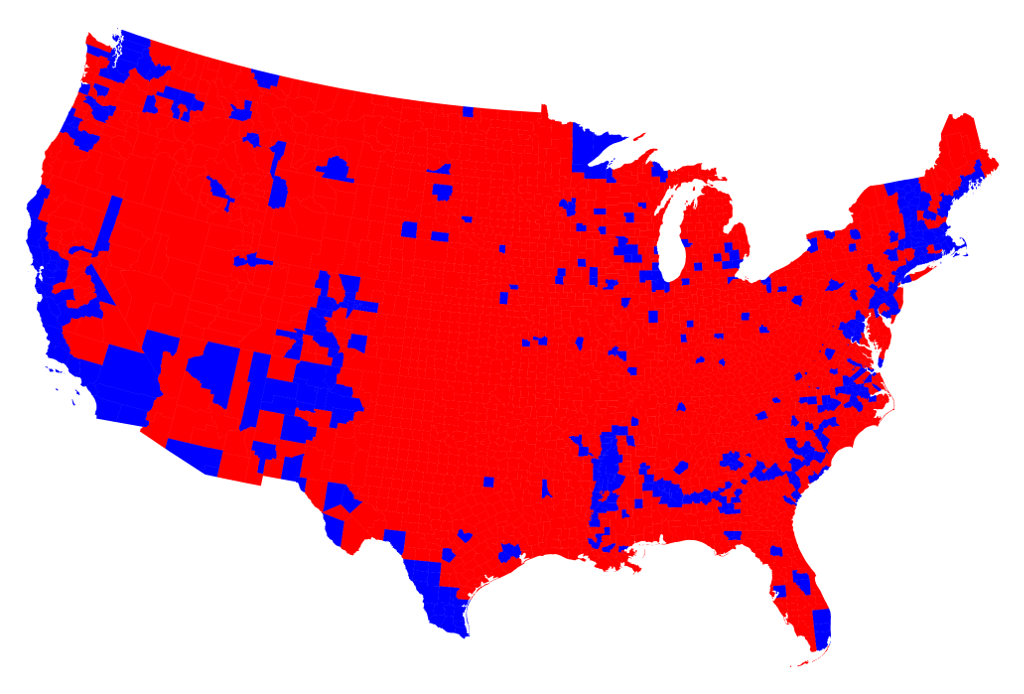
This is an election year in New Zealand. We vote for our parliamentary representatives and indirectly for our prime minister and government. Under our Westminster system the executive comprises MPs from the party (or parties) with the largest number of seats in parliament. We have a particularly silly form of proportional representation where about half the MPs represent electorates but these numbers are disregarded when considering the overall makeup of parliament, which is determined by the total of the party vote. To demonstrate how this would have worked with the US presidential election, Donald Trump may have won 30 of the 50 states and 80% of the counties in America, but Hillary Clinton would have become president under our system.

The proportional representation system gives minor parties power far in excess of their support and means the major parties often cannot really implement any of the policies on which they campaigned. As a result we have had successive governments that have pursued pretty much the same middle-of-the-road policies and have seen a gradual increase in the role of the state in our lives. There is little possibility that a party with radically different policies could ever get enough support to change this gradual progressivism. This is similar to the state of affairs in most Western democracies where the slightly left-of-centre party and the slightly right-of-centre party take turns ruling with essentially the same policies. Donald Trump's election, like Brexit, was the exception, where people said to hell with the same-same and took a punt on something different.

The lack of real choice in policies between the major New Zealand parties, National and Labour, could cause New Zealanders to look for alternatives in this year's election. One of the alternatives is the New Zealand First party led by Winston Peters, a perennial politician whose fortunes have risen and fallen several times over the past four decades since he was first elected as a National Party member of parliament. Peters' political career to date reached its zenith when he was deputy prime minister in National Party Prime Minister Jim Bolger's coalition government between 1996 and 1998. He again reached the top table of New Zealand's government when he served as Labour Prime Minister Helen Clark's foreign minister between 2005 and 2008. Peters has much in common with Donald Trump with his populist appeal to disaffected voters (in Peters' case mainly the elderly) and his nationalist and anti-immigration policies are reflected in New Zealand First's name, which sounds like a ready-made cap logo. His party is rising in the polls and is currently level-pegging with the third-placed Green Party on 11% of the national vote.

We approach the forthcoming election with extra uncertainty because of the resignation of popular prime minister John Key at the end of last year. Bill English, who was Key's deputy, has less personal appeal amongst voters than Key (although I like English because he has at least the semblance of principles whereas John Key clearly had none). English has been leader of the ruling National Party before, having led it to its worst electoral defeat in 2002, gaining barely 20% of the vote against the popular Helen Clark. So while National still leads the polling with nearly half the prospective vote, the gap to Labour is narrowing and if New Zealand First continues to eat into the vote share of the major parties, Winston Peters could well end up at least holding the balance of power again. My guess is that this time around, Peters will demand even more than in previous coalitions and could end up dictating many of the new government's policies.

It is hard to see the New Zealand political landscape changing much in the short term but Trump and Brexit have taught us that things can move very quickly. New Zealand doesn't have the same groundswell of political division and frustration that existed in Britain and the United States prior to their plebiscites last year, but I think New Zealanders are complacent and significant change could catch us unawares.

To paraphrase the Chinese curse, we live in interesting times.

Monday, December 5, 2016

John Key hasn't made NZ a better place


So John Key, Prime Minister of New Zealand for nearly three parliamentary terms, is to resign. Some of the more alarmist media have expressed shock, but others predicted it some time ago. My initial reaction was to tweet the above comment but on reflection I am not so sure that he has left the country no worse than he found it. Certainly it is not as good as it might have been after 8 years of government led by a National Party that is meant to stand for "equal citizenship and equal opportunity, individual freedom and choice, personal responsibility, competitive enterprise and reward for achievement, and limited government". John Key's government that has given us the notorious FATCA tax law, the draconian GCSB Amendment Act, a retreat from the principals of equality before the law and universal democratic suffrage, a heavy-handed and authoritarian response to the Christchurch earthquake that has hamstrung that city's recovery and the country's economic growth, and a myriad of other erosions of individual freedoms and expansions of government interference in our lives.

Some commentators have predicted that Judith Collins might follow Key as leader. Frankly, I think her selection would be electoral suicide for the National Party as Collins remains deeply unpopular after her resignation following various scandals during National's second term in office, despite Key reappointing her to Cabinet. The alternative seems to be Paula Bennett, but I doubt whether the latter has the necessary political presence and support amongst her colleagues to get the top job. The current deputy prime minister, Bill English, will be the caretaker until the National caucus votes on a new leader but he is hardly an inspiring choice to take the party into next year's election.

This country remains relatively free, prosperous and safe - perhaps one of the best places in the world to live based on these criteria, but under John Key the trend has not been positive and I hold out no hope that a new prime minister will reverse it.

Friday, July 8, 2016

Ridiculous and dishonest excuses for housing bubble

Today we have the extraordinary spectacle of the Reserve Bank of New Zealand blaming immigrants for this country's housing price bubble and calling on the government to review immigration policy. This comes after the Prime Minister criticised the Reserve Bank for not acting to restrict the access of property investors to bank loans.

I am not sure which of these two calls is the more ridiculous but both are equally dishonest. The inflation in the property market in is due in large part to the massive expansion in the money supply, which the Reserve Bank manages, fueling demand in the property market, but it is also due to supply-side restrictions driven by an onerous regulatory environment. The latter is mostly due to the byzantine Resource Management Act, which allows territorial authorities to tightly restrict the supply of new land and which imposes huge compliance costs on builders and developers, but also to the increasing burden of a myriad of other laws such as new Health and Safety at Work Act.

It seems that John Key and his officials will do anything but admit the true causes of the housing bubble. Whether you look at demand-side or supply-side issues they are all of the government's making and the fact that two arms of government are blaming each other for the problem makes it clear where the blame lies - and it isn't with immigrants. Instead of looking to scapegoats, the government should be looking at themselves and their policies.

Sunday, March 13, 2016

Flag referendum a diversion

New Zealand is in the middle of a referendum to replace its flag. Countries don't often change their flags and it is usually because the nation itself has gone through some profound change, like South Africa moving from apartheid to universal suffrage, which is why the proposal to change New Zealand's flag has engendered interest around the world.

I haven't taken much interest in the issue until now. I didn't vote in the first referendum to select one of five designs for a run-off against the current flag and it wasn't until I saw the final voting paper sitting on my desk that I decided I should complete the form and send it in. I voted to retain the current design, not because I particularly like it but because I like the alternative even less. It looks (as Steve Braunias in the New York Times accurately described it) like a beach towel or, in my view, like an emblem that our big dairy exporter, Fonterra, might put on one of their packets of cheese.

The proposed and the current flag designs
The problem is, the proposed design doesn't really look like a flag. Perhaps that is because flags are inherently conservative and the new design is a bit garish. More precisely, it looks amateurish, like something a graphic art student working as an intern in a design studio might come up with - the sort of design the senior partner would quietly drop into the waste paper basket on the way into the pitch to the client.

Prime Minister John Key has backed the change, expending a little from his enormous bank of political capital on the exercise. Polls indicate the change will be rejected and some commentators like Braunias have predicted that the referendum loss will knock Key's credibility. I don't think New Zealanders really care enough about the issue for it to make much of a dent in Key's popularity. The whole thing is a diversion from the worsening economic situation in New Zealand (with the Reserve Bank unexpectedly lowering interest rates last week in recognition of the relatively bleak outlook). But perhaps that was exactly what John Key intended.

Thursday, October 29, 2015

Why the West is looking to more radical candidates

We are seeing an interesting political trend across the globe at the moment and that is the rise of more radical political candidates. It started with the surge of UKIP in Great Britain and the libertarian presidential candidate Ron Paul in the United States, and more recently has seen the election of the Marxist Jeremy Corbyn as leader of the UK Labour Party and Socialist Bernie Sanders' candidacy for the Democratic Party presidential nomination. You could say Donald Trump is part of the trend, but Trump is less radical than any of the others (although he does represent an anti-establishment sentiment in the Republican Party). While we have yet to see the support for these more radical candidates translate into real political office, it is entirely possible one of them may end up leading their country in the next few years.

So what is happening here? Is it a hardening of "divisive politics" as Barack Obama would have us believe? Well, I guess you could call it that. What I think it is more precisely is a retreat from centrist politics.

If we look at major political shifts in the Western world since the Second World War, it is fair to say that there has been some significant swings. There was definitely a swing to the left up until the late 1970s. Britain, most of Europe, and even the United States saw a huge expansion of the role of the state, the rapid growth of welfare, and a corresponding increase in income taxes until they were at exorbitant levels (e.g. marginal rates of more than 90% in Britain). Then came Margaret Thatcher, Ronald Reagan and, here in New Zealand, the Lange-Douglas Labour Government. These leaders hauled back the expansion of the state and reduced taxes. Since 1990 most Western countries have been retreating from the more libertarian policies of Thatcher, Reagan, et al, and we have seen the rise of the 'third way' (as Tony Blair dubbed it), supposedly a middle ground between rampant socialism and hard-edged capitalism.

In reality, the so-called third way was really no way, at least in a philosophical sense. It represented the lack of a political philosophy, an anything-goes (or more precisely anything-that-can-win-an-election) approach to policy making. John Key's government here in New Zealand is the epitome of it and David Cameron in Britain is another archetype. They see themselves as pragmatists and believe everything should be a compromise.

The truth is that most people have a basic political belief system. It might not be very well-defined but they can tell you whether they think the state is too big or whether it should care more for the poor, whether we should raise or lower taxes, whether abortion and gay marriage should be legal, etc. They often hold strong views on these issues and don't like to compromise those views. The politics of compromise actually satisfies no one.

One of the problems for those of us on the classical liberal side of the political spectrum is, as Mark Steyn is fond of saying, we've lost the culture war. When almost every university lecturer, musician, film star, writer and other public figure is parroting the socialist-environmentalist mantra, there is only one side of the debate that is expected to compromise. You see this when President Obama talks about divisive politics - he's not talking about Democrats failing to compromise, is he?

The other problem that we've got is what James Delingpole so poetically calls the 'dog-shit-yoghurt problem'. If I like yoghurt and you like eating dog shit, the pragmatist says we should both eat dog-shit-yoghurt. I'm sure you can see the problem with this compromise, particularly for the yoghurt lover. Libertarians essentially want the government to leave us alone to get on with our lives. We don't need to force our beliefs on anyone else - we just need effective constraints on others forcing us to do things. Socialists want the government to interfere with everyone's lives, not just their own, because socialism doesn't work if it's only for those who want it. So they are always more willing to use force.

I think the polarisation of politics is not a bad thing for libertarians because it forces people to examine the arguments and decide what they really believe. When people have had no choice but to eat dog-shit-yoghurt for years, it is not a bad thing for the yoghurt seller when they are forced to choose between the two dishes.

Wednesday, September 16, 2015

Give me a principled Marxist over an unprincipled Tory squib any day

There has been a great deal of comment about the removal of Australian Prime Minister Tony Abbott and his replacement with that country's sixth prime minister in eight years, Malcolm Turnbull. Tony Abbott deserved to be defenestrated - not because he was (as some pundits have claimed) too ideological, but rather because he compromised his ideology where he shouldn't have and didn't compromise it where he should have done so. He stuck to his guns on gay marriage in spite of the mood for change but broke a lot of election promises in areas such as health and education reforms, lowering taxes and repeal of the Orwellian Section 18C of the Racial Discrimination Act. He did stand by his position on repealing the repressive climate tax (which Labor PM Julia Gillard had introduced after breaking her election promise not to), but that was a rare show of backbone in an otherwise invertebrate performance.

Malcolm Turnbull's admiration for John Key says everything any New Zealander needs to know about the new Australian PM. John Key may have his strengths (um...his common touch and a nice smile, perhaps?) but standing on principle is not one of them. Key promised in the 2008 election not to introduce an Emissions Trading Scheme and that went out the window with many of his other promises as soon as he was ensconced in the office at the top of The Beehive.

The interesting thing about principles in politics is that it is only those on the left are allowed to have them. Liberal Party politicians in Australia, Conservatives in Britain and National Party members in New Zealand are all condemned as too ideological if they stick to their ostensible principles like small government, free markets and freedom of choice in education and health. But you can have the most extreme left-wing views and the mainstream media and chattering classes will give you a free pass. You can be an out-and-out Marxist, willing to nationalise all manner of private businesses without compensation, want to withdraw from any Western defence alliances, and be a supporter of terrorist groups like Hezbollah, and your reward is to be elected Leader of the Opposition in Britain.

But I actually admire Jeremy Corbyn more than Tony Abbott, Malcolm Turnbull or John Key. Give me a principled Marxist any day over an unprincipled Tory squib like David Cameron. At least you know where you stand with a Marxist.

Thursday, January 29, 2015

Eleanor Catton's views are tediously predictable

There has been a great deal of comment here in New Zealand about Mann-Booker Prize-winning author Eleanor Catton's comments to an Indian literary festival. No country likes its prominent citizens being disloyal and New Zealanders seem to be particularly sensitive about this sort of thing. Personally, I think it is a bit of a storm in teacup and I have to say I agree with some of her comments, particularly the bit about the strange belief New Zealanders had (at least up until recent years) that their writers were less great than writers from Britain and America. I suppose the only part of her comments that is disappointing to me is her statement about the current middle-of-the-road John Key-led government being "neo-liberal, profit-obsessed, very shallow, very money-hungry politicians who do not care about culture."

Anyone who regularly reads my blog will know that I am no fan or defender of the Key Government and it is not that Catton is criticising the government that disappoints me. It is rather that her left-wing views are so damned predictable. Writers, actors, musicians and others in the so-called creative sector are tediously conformist in their politics and, in my view, invariably hypocritical and disingenuous. I can only interpret Catton's comment about the government not caring about culture as meaning it does not care enough about her cultural output to bestow large sums of money on her personally.

Actually, there are a few exceptions to the tedious political conformity of the entertainment sector and one that comes to mind is British singer Adele. Her comments several years ago on high taxes and the National Health Service were a breath of fresh air. Likewise, James Blunt's recent response to a senior British Labour MP's comments about Blunt's 'privileged background' were brilliantly apt. I am sure there are many more singers, writers and actors who don't share the left-wing faith of many of their peers. It is a pity more of them don't have the courage to say come out publicly and say so. Certainly, there is nothing brave in Eleanor Catton spouting her entirely predictable, run-of-the-mill, bien pensant views.

Sunday, December 7, 2014

Biased BBC Typical of State Broadcasters

British Prime Minister David Cameron and his finance minister George Osborne this week attacked the BBC as biased, accusing it of systematic exaggeration in its coverage of the Cameron Government's mini-budget, known as the Autumn Statement. What seems to have particularly riled the Tories is the claim by a BBC political reporter that the budget would take Britain back to the economic conditions described in George Orwell's novel, The Road to Wigan Pier. The only thing about this that surprises me is that Cameron and Osborne are surprised by the obvious left-wing bias of the state broadcaster.

Here in New Zealand the media, and in particular the state-owned broadcasters, show similar political partisanship. A few days ago I was in a taxi and the cabbie was listening to Radio New Zealand National's Morning Report programme, which has a heavy focus on coverage of local political affairs. Now, I stopped listening to National Radio during the 2008 election campaign when the station made no attempt to hide its hugely biased coverage in favour of then Labour Prime Minister Helen Clark over (successful) centre-right National Party challenger John Key. I was tempted to ask the cabbie to turn it off but decided it would be interesting to see whether National Radio's coverage of politics had become any more even-handed. There followed the most appalling radio interview I have heard in a long time. The reporter, unable to bait her cabinet minister interviewee into conceding what she wanted, resorted to the sort of petulant hectoring one would normally only hear in a drunken pub debate. This endured for five minutes with the cabinet minister maintaining her position calmly and the reporter becoming ever more belligerent.

Of course there is a very logical reason why state broadcasters should be biased towards left-wing political views and that is that state ownership and forcible tax-payer funding of broadcasting services only makes sense to those with Socialist views. It is simply self-interest and self-preservation.

There was perhaps a legitimate economic argument in favour of the state getting into broadcasting in the early days of radio and television, when the entry costs were a high barrier to the private sector, particularly in small countries like New Zealand. It could be argued that if the New Zealand Broadcasting Corporation hadn't established a television network in New Zealand in 1962 then this country may have gone without television for many years after that. Personally I think this is doubtful and in a free market it wouldn't have taken long for small, local television broadcasters to become established (and deregulation in 1989 proved this by quickly leading to the establishment of the privately-owned TV3). But even if such economic arguments had some legitimacy years ago, in the current environment when anyone with a personal computer can set up their own Youtube channel or streaming radio channel, such arguments are ridiculous.

The answer for David Cameron is that he should privatise the BBC. It is the dominance of the BBC and Radio New Zealand through state funding and protection that gives them their political power. In a highly competitive market, the biases of one broadcaster would not matter. 

Tuesday, September 16, 2014

Moment of Truth for Dotcom Will Come Saturday

When the Dotcom case first hit the news in New Zealand, I had some sympathy for the corpulent German. New Zealand law enforcement agencies, acting upon the instructions of US authorities, had grossly abused their legal powers and Dotcom's rights as a New Zealand resident by subjecting him to a humiliating arrest and confiscation of assets - all in pursuit of criminal copyright charges that even the US courts have been extremely reluctant to enforce in any case where a service provider like Dotcom's Mega-upload business has been the defendant. But any sympathy I might have had for Dotcom has evaporated as he has attempted to use his considerable wealth to pervert the New Zealand electoral process in his own interests.

I didn't watch the coverage of Dotcom's so-called 'Moment of Truth' rally last night in Auckland but I've read accounts of those who were there. The Mega-man was expected to reveal damning evidence showing that Prime Minister John Key knew about him before the New Zealand authorities acted on the US arrest warrant. Furthermore, he claimed that he was lured to New Zealand with the express purpose of the New Zealand Government extraditing him to the United States. Unfortunately for Mr Dotcom's credibility he revealed no evidence to support these claims. The only credible allegations were those by Edward Snowden (who joined by video from Russia) and journalist Glenn Greenwald that the New Zealand Government has been engaging in mass surveillance of its citizens. John Key has categorically denied these allegations and has released declassified documents that he claims support his denial.

Anyone who reads this blog knows that I am more than a little suspicious of our modern security state. The security capabilities that are meant to be directed at external threats are often used for internal surveillance and any legal constraints on their misuse are inadequate or ignored. The use of New Zealand's security agencies to enforce the copyright infringement case against Kim Dotcom is proof of this. However, the New Zealand courts have already shown a willingness to uphold Dotcom's legal rights and there is every likelihood that they will eventually dismiss the extradition case against him. But that is not enough for the the former Herr Schmitz.

I believe anyone should be able to exercise their rights to free speech by putting their money where their political mouthpiece is, but I think no one should have any illusions about what Dotcom is trying to do here. This has been a torrid election campaign with the left-wing opposition engaging in what has looked like increasingly desperate tactics to topple the Key Government. The latest polls show the National Party's support as holding at around 50% and it seems likely that, come the election next Saturday, New Zealanders will respond to Dotcom's cynical misuse of our electoral process by denying him and his political allies any representation in Parliament. 

Wednesday, March 19, 2014

Tony Benn was a great Socialist

I have been a libertarian since university but in politics I hold the greatest contempt not for those who have diametrically opposed political beliefs but rather for those who insist on always occupying the so-called "middle ground." At university one of my best friends was a revolutionary Marxist. He used to joke that "come the revolution you'll be first up against the wall...bang, bang, bang!" My response was always, "not if I get to you first!" We both knew that neither of us was entirely joking and that, given the right circumstances, we might one day find each other on opposite sides of a fight that involved more than just rhetoric, but we were best mates nevertheless and liked nothing more than a heated political debate. Occasionally we found common ground, such as our contempt for crony capitalism and religious conservatives.

When I lived in the UK in the 1980s there were two politicians whom I admired. Both towered over their peers in the philosophical sense. Margaret Thatcher, of course, was the first of these. The other was Tony Benn. The former Viscount Stansgate (for Tony Benn had renounced his peerage in the 1960s so he could sit in the House of Commons) was a doctrinaire Marxist and as such, I had little in common with him politically. But I admired his principled beliefs and his forthright manner in expressing them.

Benn believed in a pure, democratic Marxism that is, in my analysis, as illusory as fairy dust. He stuck to his principles, even when they put him in conflict with those who would ordinarily be his allies. He detested the Soviet Union and he was as much a thorn in the side of the Labour leadership as he was to the Tories. I had the impression that there was a reluctant mutual respect behind the open contempt between Benn and his political nemesis, Margaret Thatcher. Certainly, he had a sense of humour where Thatcher was concerned, introducing to parliament in 1990 a private members' bill entitled the Margaret Thatcher (Global Repeal) Bill.

Tony Benn died last week aged 88. I tip my hat to him as that rarity in politics these days - a man of principle and courage. Give me a Tony Benn any day over the unprincipled likes of Tony Blair, David Cameron or John Key.

Monday, January 20, 2014

Taking up the cudgels again in 2014 in defence of individual rights

I have had a very relaxing start to the year, partaking of some great weather, wonderful sights, delicious food and fine wines in some of New Zealand's most beautiful holiday spots. The relaxation was undoubtedly enhanced by confining my holiday reading to some excellent books (Donna Tartt's The Goldfinch and Bill Bryson's One Summer stand out) and consuming as little of the execrable mainstream media as possible. But it is time to return to the challenges that will face us in 2014.

In New Zealand, the Government led by John Key seems to be determined to pursue a political agenda that is as secretive, and frankly as corrupt, as ever. Key and his coalition of right-of-centre hypocrites and and racial determinists will continue to expand the power of the state and debase the rights of some New Zealanders in order to retain power.

Late in 2013 it the Key Government introduced a bill to enable the nefarious US FATCA regime, which I have blogged on before. FATCA treats any New Zealander with the misfortune of being born in the United States, or even born here to American parents, as "United States taxpayers that are resident in New Zealand." The Government acknowledges that the proposed law explicitly overrides the Privacy Act, Human Rights Act and New Zealand Bill of Rights Act. To what purpose does it treat some New Zealanders as non-citizens? It is to enforce a US taxation regime that is one-sided, unique in the world and inconsistent with OECD model taxation agreements. This analysis on the New Zealand legislation from the Isaac Brock Society sets out the issues in more detail.

Another nefarious piece of legislation the Key Government introduced in late 2013 is the Treaty of Waitangi settlement bill that gives redress to the Ngati Toa tribe for alleged wrongs committed against the tribe by the Crown in the early 19th Century. These Maori grievance settlements have become more and more outrageous over time, establishing two classes of citizenship in New Zealand - a privileged Maori tribal citizenship and lesser rights for the rest of us - but this one really takes the cake. Ngati Toa was the tribe of chief Te Rauparaha who committed what can only be described as genocide against other Maori tribes in his violent rampage through the North Island and top of the South Island in the 1820s and 1830s. British forces intervened against Te Rauparaha and his nephew Te Rangihaeata in the late 1830s and 1840s, stopping their horrific attacks against other Maori tribes and European settlers. Giving compensation to Ngati Toa today for the actions of British forces is like giving compensation to Bosnian Serbs for what happened at Srebrenica in the 1990s. Former Maori Treaty claim researcher John Robinson provides background and opinion on this claim in this article.

In the United States the Obamacare legislation is being shown up for the disaster some people always knew it would be, with even former supporters shocked to discover the huge cost increases that it is imposing and President Obama being exposed as having lied through his teeth when he said Americans would be able to keep their existing healthcare plan. Supreme Court Justice Anthony Kennedy said the legislation would "change the relationship between the government and the individual in a profound way." He meant that socialised medicine makes citizens dependent on the state in a way that Americans have traditionally not been, and he is being proved right.

On the positive side in America, President Obama has said he will rein back the extent of spying on citizens and foreign leaders that were exposed by NSA whistleblower Edward Snowden. Many commentators have said the president's pledge does not go far enough and have expressed scepticism about whether there will be any meaningful change. Obama has pursued more prosecutions under the Espionage Act than all other presidents combined, so people are right to be cynical about his intentions.

So as much as I enjoyed my holiday and have been slow to take up the cudgels again in defence of freedom, I am mindful of Thomas Jefferson's (or Edmund Burke's similar) saying, "All tyranny needs to gain a foothold is for people of good conscience to remain silent."

As Shakespeare said, "Once more unto the breach, dear friends, once more..."

Friday, August 23, 2013

New Zealanders to get it good and hard

So, the New Zealand Parliament has passed into law the odious GCSB Amendment Bill that allows the government free reign to spy on its innocent citizens.  In today's political environment, where vague threats of terrorism justify almost any repressive act of government (such as kidnapping people off the streets of friendly nations, summary executions of individuals anywhere in the world with unmanned drones, and torture to obtain confessions), it does not surprise me that the New Zealand Government wants to join in all the fun. What surprised me about the debate leading up to this law passing is the depth of support that Prime Minister John Key has for these dictatorial spying powers.  I guess it just goes to prove what I've always suspected - most New Zealanders are more interested in feeling secure (not matter how much of an illusion that might be) than freedom.  That is, of course, why we have one of the world's most extensive welfare states.

H L Mencken said, "Democracy is the theory that the common people know what they want, and deserve to get it good and hard."  Well, New Zealanders are going to get it good and hard.  As the vacuous waiter said, "Enjoy!"

Wednesday, August 21, 2013

A Sad Day for New Zealand

Today, if Prime Minister John Key gets his way, the GCSB Amendment Bill and Telecommunications (Interception Capability and Security) Bill, will pass their final reading in the New Zealand Parliament and become law.  For those overseas folk who have not been following the progress of these prospective laws, they have been introduced by the Prime Minister (who is also the cabinet minister in charge of the security services) because it was discovered that our Government Communications Security Bureau (NZ's equivalent of America's NSA and Britain GCHQ), had been illegally spying on New Zealand citizens and residents.

GCSB is part of the "Five Eyes" close community of anglophone government security officials that includes USA, Britain, Canada and Australia.  We know from the revelations of Edward Snowden and Bradley Manning that the United States and its intelligence allies have been circumventing their own laws by spying on their citizens without warrants or with unconstitutionally broad warrants from patsy judges.  We know, for example, that these agencies have used each other to spy on each other's citizens, thereby avoiding legal restrictions on domestic surveillance.  In the case of New Zealand, it was revealed that the GCSB was illegally spying on Kim Dotcom, a New Zealand resident, at the behest of the US authorities - as well as many other New Zealanders.  The response of our Prime Minister and Government was not to prosecute those security agency officials involved but rather to change the law to allow GCSB to spy on New Zealanders. The only oversight will be that of the Prime Minister and an official he appoints.

There is something very worrying about a government changing the law to make legal that which is has been caught doing illegally.  It completely subverts the principles of the Rule of Law and makes a mockery of the law itself.  Why would anyone have respect for the law if the government itself does not?

The Prime Minister has justified the change on two main grounds, firstly because of some vague threat from New Zealanders being trained by Al Qaeda, and secondly because he says he will apply it judiciously.  In regards to the first justification, I simply do not believe there is a credible and immediate threat to New Zealand from Al Qaeda. I am sure John Key has been told there is by US intelligence agencies but they would tell him that, wouldn't they?  In regards to the second justification, why would we trust his discretion in a matter where it is clear he knew about the law-breaking in the first place (at least in the case of Kim Dotcom)?  In any event, such grounds do not begin to justify the sort of wholesale invasion of innocent citizens' privacy we have already seen in the US and now increasingly in this country.

We live in a Westminister democracy.  The Prime Minister is accountable to Parliament, not the other way around.  These bills will pass today with a majority of one vote unless someone in the governing National Party or its allied MPs John Banks and Peter Dunne choose to vote against it.  I think it is a forlorn hope that one of them has the principles and gumption to cross the floor on the final vote.  It will be a sad day for New Zealand if none of them does.

Wednesday, September 19, 2012

The Economic Outlook for New Zealand

This morning I went to a breakfast lecture given by ANZ Bank chief economist, Cameron Bagrie.  The high point of the morning was the excellent buffet breakfast, which is not to say Bagrie didn't speak very well - it was just that his message was very downbeat.  That makes him an unusual beast in the economist herd at the moment, with many of his profession both here and overseas being little more than mouthpieces for their profligate governments.

The message was simple: New Zealand is one of the most indebted nations in the world (when public and private debt is included), up there with Spain and Greece.  While New Zealand is enjoying economic growth in the 1 - 2 % range, even that modest level growth is built on record high commodity prices in recent years, which are now heading south very quickly.  Add to that the very slow recovery of our second largest city, Christchurch, from its devastating earthquakes and the fact that all our key export markets are in a worse economic state than ourselves, and you have solid evidence for a poor economic outlook.

Bagrie saw the solution as being conservative economic management combined with growth from natural resource-based industries such as mining, water and energy.  He said that finance markets saw both Finance Minister Bill English and opposition finance spokesman David Cunliffe as fiscally conservative and I suppose when you compare them with Ben-$400Bn-QE-per-month-Bernancke in the United States and the new President of France who wants to increase the government's share of GDP from 50% to 60%, they do look pretty conservative. Personally, I see Bill English's expectation of a balanced NZ government budget by 2014/15 (on the condition that we achieve 4 - 5 % economic growth) as a long odds gamble, but it's all relative, I suppose.

The problem with Bagrie's solution to our grim economic outlook is that he was preaching to the choir.  The audience was made up of ANZ Bank's business banking customers.  These are predominantly owners and managers of small to medium sized businesses.  I imagine that almost everyone in the audience agreed with Bagrie - let's exploit our natural resources to drive economic growth.  But New Zealanders in general, and the National Government in particular, do not seem to really care about economic growth and would rather be dictated to by minority interest groups to whom exploiting natural resources is heresy.  In the past three years that it has been in power, John Key's Government has:

  • Backed down on opening up even very small areas of our national parks to mining
  • Allowed various interest groups to hold up the partial privatisation of energy companies, thereby stymying new investment in the sector
  • Brought in an emissions trading scheme that has made investment in the energy sector far less attractive
  • Got into a fight with Maori tribes about ownership of water rights.
If this type of political incompetence and spinelessness is any indication, New Zealand has as much chance of building economic growth through exploitation of natural resources as has the entire country of suddenly floating to the equator. 

So, where does this leave us?  I don't think there is much doubt that Bagrie's prognosis, in the absence of a radical increase in political courage by our leaders and a sudden Road to Damascus economic enlightenment on the part of the New Zealand voting public, is correct.  We are a train headed for a broken bridge - an economic wreck in the making.  And the problem with economic wrecks, as the likes of Greece, Spain and Portugual are discovering (or re-discovering in the case of all three countries), is that they quickly become social and political wrecks too, with riots on the streets and the rise of opportunistic political despots.

New Zealanders are complacent.  We think we're immune to the economic 'flu that ails the rest of the world.  You don't need to be a noted economist to know that we're not.  We are going to catch a very serious cold at least, and we are very poorly prepared to deal with it. 

Monday, August 1, 2011

As Good as it Gets?

I read the following in James Delingpole's blog on the The Telegraph's website today and it touched a depressing nerve:

"When Tony Blair and Gordon Brown were in charge Britain’s rapid and terrifying decline was still just about bearable. That’s because in those days you could console yourself that they would sooner or later be swept away by a Tory regime which would swiftly set about undoing all the damage they had done. But just look at the mess we’ve landed ourselves instead: I feel like a bit like a wartime Polish officer who has been rescued from the Germans, escaping execution by the skin of his teeth, only to discover that his liberators are the NKVD.

The worst of the many awful things about Cameron’s bastard Coalition is this: you know that where we are now is going to be about as good as it gets."

It is exactly how I feel about the John Key-led coalition government in New Zealand.

Sunday, May 22, 2011

Neither Government nor Opposition Will Solve NZ's Economic Problems

We have finally seen a response to New Zealand's economic problems in the National Government's Budget (problems that were clearly illustrated in the Budget document). But it is hardly a brave and decisive response, delivering only small changes to the state's subsidies for the KiwiSaver savings scheme, slightly less generous conditions on borrowing under the Student Loans scheme (but it is still interest free) and slight adjustments to the Working for Families welfare-for-all scheme that Prime Minister John Key called "Communism by stealth" when he was Leader of the Opposition. None of these things will go far in addressing the New Zealand Government's huge operating deficit. The Government claims it will go into surplus in 2014 but this is dependent on achieving 4% p.a. growth in GDP - an unlikely prospect if the country's recent economic performance is anything to go by.

And what of the Labour Party's policies? Since the Budget Phil Goff, Leader of the Opposition, has announced that Labour will:
1) Establish a Ministry of Children
2) Restore research and development tax credits that National abolished
3) Pay for the above by bringing agriculture into the comprehensive Emissions Trading Scheme (ETS) two years earlier than planned.

Of these policies only the second is likely to have any beneficial economic effect. Establishing a Ministry of Children will be a cost with no benefits (not even to children's welfare, in my opinion) and extending the ETS earlier than planned will only increase the direct costs to the economy of this pernicious scheme, again with no benefits (given New Zealand produces just 0.2% of total global anthropogenic carbon emissions).

So neither party's policies are going to address New Zealand's slide into the sort of economic hardship of the type currently being suffered by the PIIGS countries (as discussed in this blog). This is because neither party contains any politicians with the intestinal fortitude to tackle the problem. Our politicians of all persuasions are pathetic, poll-driven, moral pygmies who would rather see our country become destitute than risk their popularity to implement the reforms that are necessary to generate economic growth.

I believe our politicians grossly underestimate New Zealanders' intelligence and integrity. I believe most New Zealanders understand our current economic plight, especially since the Christchurch earthquakes, and are willing to accept far greater austerity measures than this Government has introduced with its Budget. But it would take a leader with more courage than John Key or Phil Goff have ever shown to risk his or her political career to do what needs to be done.

Thursday, February 3, 2011

Why New Zealand is well on its way to Third World status

I read in Not PC's blog that the assets controlled by the NZ Government (including local government) are six times the value of the listed companies on the New Zealand stock exchange. I found this such an incredible statistic I decided to look into it myself. This discussion was in the context of Prime Minister Key proposing to look at the partial sale of shares in some state owned enterprises (SOEs) if his government is re-elected later this year. The proposal is only to sell minority stakes and is hardly a wholesale reversal of the previous Labour Government's steady nationalisation of companies such as Air New Zealand and the Tranzrail but it was enough to set the fox among the chattering chickens of the media and political commentators.

Amazingly, the statistic is true. I believe Not PC got the statistic from ACT MP Muriel Newman's blog, who in turn quoted it from former National Party leader Don Brash's last "state of the nation" speech to the Orewa Rotary club (a tradition started by 1970s/80s prime minister Muldoon). One thing you can say for Don Brash is that he does his research. My own investigations reveal that the total value of shares listed on the NZSE is currently about $56B. The total assets of the Crown in the latest Treasury financial accounts is $223B. Local government assets are approx. $98B. So the total value of all government assets is around $320B or six times the value of the shares on the stock exchange. The government has $95B invested in SOEs and investments including the government's superannuation fund, although the net asset value would be somewhat less than that. New Zealand has a total "capital stock" of about $570B, so the Government's share of that is around 56%.

It is difficult to do direct comparisons with other countries but New Zealand's figure seems to be unusually high. The US Federal Government's assets are only about US$3 trillion of a total US asset base of approx. US$200 trillion (1.5%). Okay, that doesn't include the assets of state governments but even if they are ten times the federal value they are still a much smaller proportion of national assets than New Zealand's. The last figures for Australia I could find had the Federal Government assets at about A$350B compared with a total national asset base of more than A$5 trillion (7%). Again, it doesn't include state governments but you get the picture.

When commentators look at government involvement in the economy they only tend to look at government spending as a proportion of GDP and on that measure (39%) New Zealand is on a par with other countries. But based on these asset ownership figures, our government completely dominates the economy. In fact, I'd guess we have one of the highest levels of government asset ownership in the world.

I hear the lefties saying, so what? Well, I believe that this is a significant factor in New Zealand's poor economic performance over past decades. We have slipped from number 3 or 4 on the OECD table of GDP per capita in the 1950s to number 23 today. That is an appalling decline that we should be ashamed of. In the 1950s we were ahead of Australia in GDP per capita and now they are 45% ahead of us (and unlike us they are still well above the OECD average).

So why has New Zealand done so poorly in comparison to almost every other Western nation? The asset ownership figure provides an obvious answer: our inability to grow wealth in our private sector (which, after all, is the only place wealth is ever grown). Every country that has prospered over the last few decades has done so on the back of building large numbers of significant new private sector enterprises. In Scandinavia it has been high tech industries such as mobile phones and software, in the United States it has predominantly been in IT and entertainment products, and in Australia financial services, manufacturing and mineral exploitation. What has happened to New Zealand by comparison? Well, we've destroyed all our large companies through mismanagement and heavy-handed Government intervention. Think about it. What happened to Fletcher Challenge, Carter Holt Harvey, BNZ, Watties, Brierley Investments, and pretty much all the other big companies we used to have. They have been either taken over by foreign owners or are shadows of their former selves or they don't exist at all. And don't quote Fonterra as an exception - that's a state sanctioned monopoly that hasn't progressed beyond the low-value commodity producer it has been since the 1930s.

Oh, what about all the new technology success stories, Navman, Xero, TradeMe and so on? Well, even the largest of these are small fry in comparison with a Fletcher Challenge.

But, I hear you say, no one likes big business anyway and most New Zealanders are happy with their lot. Standard of living is not all about financial measures and aren't we one of the happiest societies in the world? So let's examine what will happen if we continue to slide further down the OECD ladder.

In another decade or two, at current rates of decline, most New Zealanders won't be able to afford to travel overseas at all. The tradition of overseas experience, especially for our young people, will be beyond our reach. We won't be able to afford to pay the welfare benefits we currently pay or the generous superannuation scheme we have for our retired people. We won't be able to keep our hospitals and schools running at current levels and certainly won't be able to buy the best drugs and medical equipment. We won't be able to have all those neat technology devices we crave, like iPhones and flat screen TVs. Forget the late model motor vehicles and the fancy imported foodstuffs and seeing foreign artists perform in our stadiums, or any of the other miriad of First World luxuries we take for granted.

You don't believe me? Just take a look at Greece or Portugal or Ireland at the moment. These countries lived beyond their means for too long and are now paying the price. Some of my friends and relatives in these countries, even the well-off ones, can no longer afford to travel. Interestingly, of these three countries, in spite of their economic troubles, only Portugal is below New Zealand on the GDP tables.

So what is the solution? It's simple really; we need to double the size of our private sector without increasing (and ideally reducing) the size of the public sector. That means a massive shift of investment and expenditure from the public to private. It means providing huge incentives, through tax breaks, for investment in the private sector and cutting our public sector cloth to suit. It won't be sufficient to match other country's tax incentives, we will have to be well below them to attract the investment we need. That is the simplest and the only solution. Don Brash and his 2020 Taskforce have been saying it and most economic commentators worth their salt have been saying it. I'm sure many New Zealanders don't want to hear the message but they need to understand the consequences of not doing it. Hopefully they will wise up before we drop completely off the bottom of the OECD list. Then we will be Third World, perhaps the only country in history to suffer the ignominy of going from the mansion to the poorhouse.

Thursday, February 11, 2010

But what do you expect from TVNZ?

Some folks are getting terribly upset that Television New Zealand, the state-owned company that runs the two leading network channels in this country, saw fit to bump Prime Minister John Key from their primetime current affairs show, Close Up, in favour of a former rugby player who was involved in what can only be described as a rather trivial sexual harassment matter involving a 15 year old girl. Prime Minister Key had just announced his Government's major economic and taxation policies for the next few years but TVNZ decided that this wasn't nearly as important as the former rugby player's peccadillos.

I'm actually blase quite about this. That's because I have long since given up watching TVNZ's news and current affairs, having decided that their coverage of news events is comparable to that of the joke publications News of the World in the UK and National Enquirer in the USA. The only thing that disappoints me is that the viewing public of this country still expects anything better from TVNZ.

It is high time the Government split up and sold TVNZ. Why the taxpayer needs to own and fund a commercial television company, I do not know. But to own an enterprise with as poor standards as this one, well, that is just ridiculous. It's like the British Government owning the News of the World or the US Government owning the National Enquirer.

Let's get rid of these crappy television channels and, while we're at it, sell Radio New Zealand as well. The latter specialises in talkback for the so-called liberal intelligentsia and runs a Soviet-style station that plays wall-to-wall strident orchestral music. The NZ taxpayers shouldn't own this rubbish either.