This got me thinking about the traditional left-right divide, a dichotomy that always frustrates me because I don't see myself as belonging to either side. Too often people like me with classical liberal views are characterised as right-wing along with others who hold quite statist and authoritarian views, such as Donald Trump.
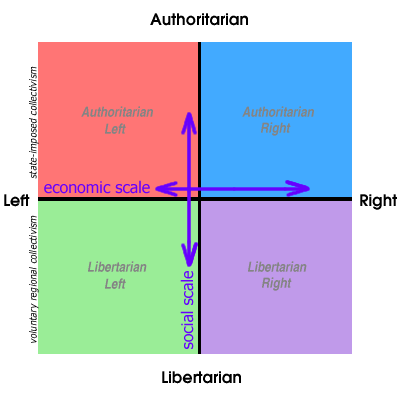
There have been attempts to build more complex models such as the Political Compass, which has two dimensions with an economic and a social scale, as shown below.

This matrix allows a more detailed representation of political views but in my view it still does not provide an completely accurate picture. For example, it puts Hitler at the very top of the social scale but in the middle of the economic scale, and Stalin on very left of the economic scale, whereas I see their Fascist and Communist philosophies as very similar in every respect. It is one of the great myths about Fascism that it allowed economic freedom. In Nazi Germany and Mussolini's Italy, private companies were permitted to operate only under the strict control of the state and only then when they served the state's interests. Thus, many companies were forced to move production capacity to armaments manufacture rather than the products their owners would have preferred to produce. That is hardly economic freedom.
The chart below shows the positions of various historical figures.
 So where do I fit on the matrix? Here is my position:

What about Donald Trump? The Political Compass website assessed the US presidential election candidates as follows:
 Trump is quite far up the social axis towards authoritarianism, as is to be expected, but perhaps not as far to the left of the economic scale as I would have thought. This is probably due to a bias in the framing of the questions that equates crony capitalism with economic freedom, which is essentially the same problem that places Hitler in the middle of the economic axis, as noted above. The closest of the historical figures on the chart to Trump is Margaret Thatcher, although I think Thatcher was significantly more economically liberal (and perhaps more socially conservative) than Trump.
Trump is the man the left-wing loves to hate but in reality his policies have far more in common with the views of those who describe themselves as 'lefties' than they do with my philosophical beliefs. It is ironic that Trump's first significant executive order was to withdraw from the Trans-Pacific Partnership agreement, an action he completed as people were marching in protest against his election. Many of those who were protesting were undoubtedly the same people who had protested against the TPP. It is revealing that in the above chart Hillary Clinton is further to the right economically than Trump - again something many of her supporters would be surprised to see.
I think there is really only one axis when it comes to political beliefs - authoritarian vs. liberal - and anyone who claims they can be at one end of the axis on social matters and the other end on economic matters is deluding themselves. The economist Milton Friedman (whose views are shown in the second chart above) said that a country could have economic freedom without political freedom, but not the reverse. I disagree - freedom is freedom, and economic freedom without social or political freedom, or vice-versa, is contradictory and unsustainable - but that is probably a subject for another blog post.
There have been attempts to build more complex models such as the Political Compass, which has two dimensions with an economic and a social scale, as shown below.
This matrix allows a more detailed representation of political views but in my view it still does not provide an completely accurate picture. For example, it puts Hitler at the very top of the social scale but in the middle of the economic scale, and Stalin on very left of the economic scale, whereas I see their Fascist and Communist philosophies as very similar in every respect. It is one of the great myths about Fascism that it allowed economic freedom. In Nazi Germany and Mussolini's Italy, private companies were permitted to operate only under the strict control of the state and only then when they served the state's interests. Thus, many companies were forced to move production capacity to armaments manufacture rather than the products their owners would have preferred to produce. That is hardly economic freedom.
The chart below shows the positions of various historical figures.


What about Donald Trump? The Political Compass website assessed the US presidential election candidates as follows:

Trump is the man the left-wing loves to hate but in reality his policies have far more in common with the views of those who describe themselves as 'lefties' than they do with my philosophical beliefs. It is ironic that Trump's first significant executive order was to withdraw from the Trans-Pacific Partnership agreement, an action he completed as people were marching in protest against his election. Many of those who were protesting were undoubtedly the same people who had protested against the TPP. It is revealing that in the above chart Hillary Clinton is further to the right economically than Trump - again something many of her supporters would be surprised to see.
I think there is really only one axis when it comes to political beliefs - authoritarian vs. liberal - and anyone who claims they can be at one end of the axis on social matters and the other end on economic matters is deluding themselves. The economist Milton Friedman (whose views are shown in the second chart above) said that a country could have economic freedom without political freedom, but not the reverse. I disagree - freedom is freedom, and economic freedom without social or political freedom, or vice-versa, is contradictory and unsustainable - but that is probably a subject for another blog post.
