Showing posts with label Green Party. Show all posts

Sunday, May 5, 2019

The Real Zombie Apocalypse

The so-called Extinction Rebellion protestors, the Swedish child who is the figurehead of the school strike for climate movement, Greta Thunberg, the extreme left-wing of the Democratic Party led by Alexandria Ocasio-Cortez, and the Green Party activists here in New Zealand, have been shouting loudly for a zero carbon emissions target within ten years. They claim that if we don't do this, mankind faces extinction. This is the exact opposite of the truth.

Dr. Patrick Moore, a biologist and environmentalist who was one of the founders of Greenpeace (notwithstanding that the organisation now disowns him), recently spelled out to American podcaster, Tom Woods the real implications of a ten year zero carbon emissions target:
It would cause an immediate collapse of the agricultural system worldwide...and that would result immediately, beginning the in centre of the large metropolises, with starvation and death, and cannibalism no doubt as it spread outwards, to end up with only a few subsistence farmers surviving in the wilds.
It would immediately result in mass death.
If we quit fossil fuels tomorrow there wouldn't be a tree left on the planet in a very short time.
He then poses the question, is this the future we want for human civilisation?

Moore's prediction is realistic. It is not climate change that poses the greatest threat ever to human beings but the policies proposed by these lunatics. Here in New Zealand, the government is already committed to a zero-carbon economy by 2050 and, as I have written before, the government's own economists have said that this will reduce our GDP by up to a quarter, so it is not difficult to envisage what adopting the same policies in less than a third of that time would do to our economy.

I am sure that some of those calling for for a ten-year zero carbon emissions target are simply naïve. Clearly, the autistic Thunberg falls into that category and perhaps even Ocasio-Cortez too (she really doesn't seem very bright), but there are others like our Green Party politicians who I know are not stupid. I believe they understand exactly what they are calling for. Their aim is the destruction of Western civilisation and its replacement with a Marxist agrarian autarky along the lines of that practiced in Cambodia during the reign of the Khmer Rouge. That experiment resulted in the deaths of up to half the population of Cambodia in just four years.

It is ironic that the theme of a zombie apocalypse has become so popular in movies and television series at the same time as these calls for the destruction of the world's energy systems, because the scenes in World War Z or The Walking Dead are a fairly accurate prediction of what will happen if the Green New Deal policies are enacted. Except it won't be zombies roaming the Earth, it will be the starving, cannibalistic survivors of humanity.

Monday, April 8, 2019

It is not racist to reject tribalism and neo-feudalism

Some left-wing politicians and commentators were quick to exploit the recent mass murder of Muslim worshippers in Christchurch, blaming it on the extreme right and 'white nationalists'. The New Zealand Green Party co-leader Marama Davidson went further, equating the attack with with oppression of Maori in colonial New Zealand and saying, "New Zealand was founded on the theft of land, language, identity and the mana of [Maori]. Here in...this very land we’re standing on, is land that [Maori] were violently removed from to uphold the same agenda that held the people in the mosque yesterday."

Auckland University historian Anne Salmond joined the fray saying, "White supremacy is part of us, a dark power in the land...it's violent and hateful, spewing out curses, incarcerating young Maori in large numbers, denying them a decent education, homes and jobs, telling them they have no future, and are better off dead." She went on to say, "Since the arrival of Captain James Cook 250 years ago, Maori have struggled to gain a nationwide acceptance of their cultural values, language and spiritual beliefs. Colonisation is one of Cook’s legacies and racism against Maori is a part of it. New Zealand has inherited a British supremacy perspective and it pervades every area of our society."

It is, of course, a battle tactic of the far left to equate any differing views than theirs with racism, but we should examine such claims for their merits. Does New Zealand have a racist, "British supremacy perspective" that continues to discriminate against Maori? And what does Salmond mean by the struggle for "nationwide acceptance of [Maori] cultural values?"

Colonisation ended in a formal sense in 1853 when Britain granted New Zealand self-government, but the first New Zealand government was democratic only in a limited sense, with a property ownership qualification for male voters. Most Maori, who did not have recognised legal title to their lands, did not qualify to vote, but this was addressed in 1867 with the establishment of Maori seats in parliament, elected by universal male Maori suffrage. Non-Maori men were not granted universal suffrage until 1879 and women in 1893. The Maori seats still exist and people of Maori descent can choose to vote in Maori electorates or be on the general electoral roll. In the last election, 24% of the seats in the New Zealand Parliament went to candidates of Maori descent, compared with approx. 15% of the population identifying as Maori, so at least in terms of democratic representation Maori do not suffer discrimination.

The argument goes a little deeper, however, and it appears to be Western liberal democracy itself that is regarded as discriminatory against Maori. This is surely what Salmond means when she says, "Maori have struggled to gain a nationwide acceptance of their cultural values, language and spiritual beliefs." She seems to support a reversion to traditional Maori tribal rule and this is precisely what those calling for greater Maori political and economic privileges mean when they talk about the Treaty of Waitangi guaranteeing a "partnership" with the Crown. It means New Zealand should have two parallel systems, a tribal system for Maori and something else (perhaps some limited form of democracy) for non-Maori. It is clear that the partnership concept means that, at a minimum, each system will have equal power, but more likely that Maori will have supremacy. 

Traditional Maori society has been compared to compared to Communism, which is probably why many left-wing activists romanticise it, but a more accurate comparison is medieval feudalism with its strict gradations of social status including aristocrats, the warrior class and serfs. Slavery was widespread in Maori society and warfare and 'utu' (revenge) were the common forms of settling disputes. The dominant units of political organisation were the iwi (tribe) and hapu (sub tribe), and there were no equivalent concepts of individual rights, personal property and the rule of law. It was certainly a very different political and social structure to what exists in modern Western democracies.

Contrary to what Salmond and others would have us believe, Western civilisation is not a racial thing. It was rooted in the classical civilisations of Greece and Rome and flourished in Western Europe during the Enlightenment, but it has since spread across the entire globe with countries as geographically and ethnically diverse as Singapore, Botswana and the Cook Islands embracing the Western ideals of individual rights, a free market economy and the rule of law.

Maori in the 19th Century took to the British way of life with enthusiasm, learning to read and write the English language, becoming educated in the Western tradition, gaining trades and embarking on professional careers, and in many cases becoming wealthy in their own right. But many Maori men also became labourers, which entailed a significant reduction in status from that of a warrior, and there was a significant element of racism amongst the European population, many of whom believed, like school inspector Henry Taylor in 1862, that Maori were "better calculated by nature to get their living by manual than by mental labour." However, that does not mean that the system is rigged against Maori today and I am far from convinced that even most Maori would want to abandon the liberal democracy we have in New Zealand.

It is not anti-Maori to resist the imposition of traditional Maori political and social systems on modern New Zealand society any more than it is anti-Chinese to oppose Maoist Communism. On the contrary, it is totalitarian to take the position that you cannot oppose such an imposition without being racist. We need to be clear about what we reject and why we reject it - we do not resist tribalism and a neo-feudalism because it is peculiarly Maori (which, of course, it is not), we reject it because it is incompatible with our values of individual rights and liberty.

It takes courage to stand up for what you believe in when you are being called a racist and implicated in such a horrific crime as the Christchurch mass murders, but we need to recognise the motivations of those who are exploiting the awful event for their political ends. They do not want a pluralistic society where differences are tolerated, they want a homogeneous world where everyone is in lockstep with their views. They call those who disagree with them racists because they want us to shut up. We must reject their premises as well as their arguments because if we don't, we'll lose everything.

Tuesday, August 21, 2018

Sooner or later, Atlas shrugs

When the new government manoeuvred its way into power in New Zealand last year I was prepared to give it the benefit of the doubt. The coalition agreements signed by the parties didn't look too extreme - they were promising to spend a lot more money but they weren't proposing to raise income taxes in this term. Their regional development policies, anti-immigration stance and ambivalence on the Trans-Pacific Partnership trade agreement actually looked a lot like Donald Trump's populist platform (although there is little in the latter that I support). The problem is that what was said in the coalition parties' manifestos and agreements was only part of the picture, as is now being revealed.

This government believes it can govern by fiat - the prime minister, Jacinda Ardern, demonstrated this when she announced her ban on oil and gas exploration without even taking it to cabinet. Other policies that her government has announced include new petrol taxes, the introduction of a Zero Carbon Act (which, based on the government's own numbers, is estimated to reduce our GDP by between 10% and 22% by 2050), increased welfare payments across the board, and raising the minimum wage to one of the highest in the Western world. The government is also reviewing tax, through its Tax Working Group, and all indications are that it is likely to introduce a capital gains tax.

New Zealand used to be known for its light-handed commercial regulation but even under the previous National Party-led government, businesses faced a raft of new, expensive and intrusive regulations such as a new and far more onerous health and safety act, an emissions trading scheme, and further controls on development in the growth-killing Resource Management Act. While the previous government lowered company taxes early in its term, most Western countries have reduced theirs further with the result that New Zealand is now one of the most highly-taxed countries for business. All of this precipitous policy-making has understandably caused a crisis of business confidence and the new government's response has been to chastise business leaders for their lack of enthusiasm. Their bewilderment at the sudden loss of business confidence shows they are a bunch of dogma-driven, wilfully-ignorant, arrogant fools.

Sooner or later, as Ayn Rand said, Atlas shrugs. Most people are happy to go along with being taxed and regulated, accepting the view that some government intervention in the economy is the cost of a democratic society, but there is a tipping point at which the productive members of society refuse to continue to be the milch cows for the unproductive. This tipping point is recognised in economics by the Laffer Curve - the empirical observation that continuing to increase tax rates ultimately results in lower revenues. Of course socialist governments often solve the problem by bringing out the guns - as we have seen in Venezuela - but history proves that free men and women are far more productive than slaves and that liberal, capitalist societies outperform repressive ones on every measure. Wise governments recognise this and backoff on the socialist policies - as the government of Sweden has done in recent years.

I have written before about how New Zealand's so-called 'rock star economy' wasn't worthy of the name even before the current jitters. It will be interesting to see whether this coalition government backs off on some of its ill-considered, dogmatic policies. If it doesn't, I think New Zealand will continue to slide into economic ignominy.

Tuesday, October 31, 2017

Three years is plenty to screw up New Zealand

One of the more interesting pieces of work I've done recently is preparing a briefing for clients on the impact on their business of New Zealand's new coalition government. I went through the details of the coalition agreements between Labour, New Zealand First and the Greens and also, with a fine-tooth comb, through their manifestos. I believe I now have a pretty good understanding of all of their promises.

The total cost of new spending over the next few years is more than $15 billion. It is not obvious how they are going to pay for it, with only a few hundred million of new revenue identified. The source of the money, of course, will be new taxes and borrowing (i.e. deferred taxes) - they just weren't honest enough to admit it in the election campaign. They have revealed only that they intend to cancel the previous National Government's proposed tax cuts for next year and that they will establish a Tax Working Group to look at the tax system. The latter sounds to me like a surreptitious means of justifying the higher taxes the coalition will require to fund all that extra spending.

The other shocking aspect of my analysis is the sheer number of new policy initiatives and laws the Labour-led government plans to introduce. I have written before of how there are ordinarily about five hundred pieces of legislation winding their way through Parliament's processes. Expect this to increase substantially. If we are not already one of the most regulated countries in the world, we are about to become so. 

I believe the coalition government won't last more than three years (and possibly considerably less). Unfortunately, three years is plenty to screw up New Zealand, given that they seem to be seriously commited to the task.

Thursday, October 19, 2017

Good luck with that, Jacinda

The people have spoken - well, a minority of them anyway. We have a coalition government that doesn't even have a plurality of the votes. After a month of dithering, the leader of the New Zealand First Party, Winston Peters, who lost his own electoral seat in last month's election and whose party was reduced to 7% of the vote, decided to form a coalition with the New Zealand Labour Party. Combined, the two parties won 44.1% of the party votes - less than the National Party's 44.4% - and yet they have been able to form a government because the Green Party, with 6.3% of the vote, is prepared to support them on 'confidence and supply' (i.e. on budget votes). 

It is not as if the partners to the polyamorous affair have much in common. New Zealand First is a nationalist, protectionist, anti-immigration party and its leader moulds himself on Robert Muldoon, the authoritarian New Zealand prime minister from 1975 to 1984 who took the country to the verge of bankruptcy. Labour is a classic, left-of-centre social democratic party, and the Greens are a typical 'watermelon' alliance of environmentalists and Marxists.

The new prime minister, Jacinda Ardern, is not only New Zealand's youngest premier in over a hundred years, she is the least experienced, having never held a full-time job outside of politics and never having held even an executive position in government. She will need to rule over a rag-tag coalition with less mandate than National to govern and to keep the oldest political fox of them all, Winston Peters, from eating all her chickens. I give it less than twelve months until her government disintegrates and we have another election.

In the meantime, I wish Jacinda Ardern and her coalition good luck and implore them not to stuff up our great little country too much before the big kids take over again.

Tuesday, October 17, 2017

Greens enable Winston Peters to hold NZ to ransom

I wrote recently about why I thought New Zealand's electoral system was the dumbest in the world, and so it has proved to be. Nearly a month after the election we still don't have a government and while I don't think this is in itself a bad thing, watching our politicians jockeying for power has been unedifying. All the blind ambition, self-aggrandisement and incompetence we have come to expect of our politicians has been on display.

The uniquely unqualified, inexperienced and unproven Labour Party leader, Jacinda Ardern, who will become our prime minister in a Labour-led government, has been displaying a quiet confidence in her public comments. Bill English, the current prime minister and leader of the National Party, which won the largest share of the vote, is more inscrutable. Meanwhile, Winston Peters, whom the media have dubbed the 'kingmaker', cannot contain his delight at being the centre of attention again and continues to make the country wait for his decision. As the Guardian newspaper put it, Winston Peters and the anonymous board of his nationalist New Zealand First Party are holding the country to ransom.

This is all pathetic but the prize for the most damaging self-indulgence must go to the Green Party, the leftist environmentalists who have refused to consider negotiating with the centrist National Party, preferring to give Labour their proxy in coalition negotiations. This has, of course, strengthened Winston Peters' hand, an outcome for which their supporters surely could not have voted. A National-Green coalition could govern without New Zealand First's support and thus even the pretence of negotiations between these two parties would have taken the wind out of Winston Peters' sails. Many commentators have expressed disappointment with the Green's holier-than-thou attitude with even former Party MP Nandor Tanczos calling for his party to enter into negotiations with National.

Winston Peters may be holding the country to ransom but it is the Greens who have given him the means to do so. I hope the voters remember that when it comes to the next election, which, I am picking, may be not that far away.

Thursday, September 21, 2017

The World's Dumbest Electoral System

New Zealand has the world's dumbest electoral system. Saying such a thing in this country provokes the same reaction as when you say, "the world is not suffering catastrophic global warming", but sometimes one must speak truth to power. There is a reason why only one country in the world had the system before New Zealand adopted it and that country (Germany) has special historical reasons for having a system that ensures no single political party can ever govern alone.

Under our Mixed Member Proportional (MMP) system, you get two votes - the first determines who becomes your local electorate member of parliament, the second is for the party you prefer. The complication comes from the fact that it is the party vote alone that determines the make-up of parliament, which means the electorate vote counts for nothing in terms of legislative power. In effect, winning electorate seats costs a party list seats. A party can get into parliament if they get at least 5% of the party vote even if they have no electorate seats, or if a party gets at least one electorate seats, it's party vote counts as well even if it gets less than 5% support. Confused? Well, you are not alone - by some estimates, 80% of New Zealand voters do not understand how the system works.

The complexity of the system produces some weird effects. Consider the following two scenarios. 


In the first scenario, a centre-left government comprising Labour, New Zealand First and Greens is the most likely outcome because even though National has far more seats than Labour, the latter will be able to form a coalition with fellow opposition parties the Greens and New Zealand First (note that for the sake of simplicity I have ignored smaller parties and the impact of the race-based Maori electorates, which further complicate the picture).

The second scenario is almost exactly the same as the first except that the Greens get 0.1% fewer votes. This means they would be wiped out because they did not reach the magic 5% threshold to get party list seats in parliament (assuming, as is likely the case, they do not win any electorate seats). National would have an overall majority of seats and be able to form a government. So, 0.1% of the votes can completely change the outcome and make the difference between significant representation in parliament for a minor party or none at all. 

The libertarian ACT Party, which is polling at 0.3% in the latest poll, will likely have at least one seat in the next parliament because they will win the Epsom electorate, whereas the Green Party, which is hovering around 5%, may get none. As a libertarian, that is an outcome I would like to see but it is hardly fair.

The system could be easily fixed by separating the effects of the two types of vote. The party vote should determine only the proportion of the party list seats rather than the overall make-up of parliament. In other words, winning an electorate seat wouldn't cost you a party list seat. I believe this is exactly how most New Zealanders imagine MMP works, so it would be aligning the system with expectations. Under this proposal, the 5% threshold could be abolished - or at least lowered to level needed to get one party list seat - and this would eliminate the bizarre effects outlined in the second scenario above.

It is time for a change in our electoral system.

Wednesday, August 9, 2017

Left's defence of Turei is remarkably shortsighted

A few weeks ago I wrote about the admission by Metiria Turei, the co-leader of the New Zealand Green Party, that she committed welfare fraud when she was younger. I had intended to leave the matter alone but have found myself drawn back to it, much as one is drawn to the sight of a rotting corpse - it is deeply unpleasant but fascinating nevertheless. More interesting than Turei's admission has been the reaction to it. An opinion poll shows nearly three-quarters of New Zealanders believe that her fraud is unacceptable but, as I said on Lindsay Mitchell's blog, it is discouraging that half of Green Party supporters, and even a significant proportion of National Party voters, think Turei did nothing wrong.

Turei defended her actions by saying it was a choice between feeding her child and complying with the law. A number of commentators have pointed out that her claim doesn't hold water, that she was living with the partner of her child and with her mother at the time she claimed a sole parent benefit. She has said she will not seek a cabinet position if the Greens are part of the government after next month's election but has refused to resign either as co-leader or as an MP. Her attitude compares with the resignation from Parliament of ACT Party MP, David Garrett, for passport fraud, which at least had the mitigation of not benefiting him financially.

This week two Green MPs, Kennedy Graham and David Clendon, resigned in protest against Turei's refusal to step down. It is reassuring to know that there are still some people with integrity in a party in which half of its supporters support benefit fraud. 

The worst thing about Turei's admission is the fact that the political left-wing have rallied behind her rather than condemning her actions. Her Green Party co-leader, James Shaw, has defended her and the new leader of the larger centre-left Labour Party has said she will work in coalition with a Turei-led Green Party. Left-wing bloggers have also defended her. 

I think the left's defence of Turei shows a remarkable lack of judgement. Do they not realise that the whole taxation-welfare state they so defend is completely dependent on the pretence that it is legally and morally right? The redistributionist system relies on the acquiescence of taxpayers because if enough people decided they did not want to pay their taxes, there is no way the state could enforce it notwithstanding the draconian sanctions available to the tax authorities. Does the left really want us to believe that defrauding the system is acceptable? It is, of course, a double-edged sword and those who are on the receiving end of the redistribution have everything to lose. 

A libertarian like me might look at all this as a good thing - anything that hastens the collapse of the system is to be encouraged. Unfortunately, the end of that road is what we see in Venezuela today and no one who loves freedom and individual self-determination wants to see that in their country.

Monday, July 17, 2017

Green leader acknowledges fraudulent basis of left-wing beliefs

Lindsay Mitchell reports that the Green Party co-leader, Metiria Turei, has announced the party's new welfare policy, which coming from New Zealand's Watermelons is entirely unsurprising, but this policy seems remarkably short-sighted even for the Greens. They propose removing all sanctions and obligations from beneficiaries, a policy that is an invitation to indolence and fraud. 

The current government has been reasonably successful in reducing long-term welfare dependency and encouraging beneficiaries to take responsibility for their lives - getting beneficiaries back into work, discouraging young women from having babies when they can't provide for them and targeting social investment at those in highest need. All the evidence points to the fact that when people take responsibility for their own lives their outcomes and that of their children are much better. 

The worst detail of Metiria Turei's reported announcement is the admission that she personally defrauded the welfare system by failing to declare that she took in flatmates while on a benefit. This explains much about the basis for her party's policy. The political left-wing likes to claim the moral high ground so perhaps we should salute Turei for her confession because it acknowledges that her policy is based on lies. Of course, the entire left-wing political philosophy is based on the fraud that is Marxism so it is refreshing to see a chink in the wall of propaganda that would have us believe there is some moral basis to it all.

This policy announcement is good in one other respect - it will guarantee electoral oblivion for the Green Party. New Zealanders like to give people a fair go but like most people they don't like to be ripped off. The Americans who voted for Trump and the British with Brexit had had enough of political lies and I believe New Zealanders will similarly punish the Greens for their dishonesty and conceit.

Wednesday, January 25, 2017

Trump and the Left-Right Divide

Recently I completed a survey that evaluated the political views of New Zealanders and matched them to the policies of the main political parties. My views, perhaps unsurprisingly, most closely matched those of the (relatively) libertarian ACT Party, but it was the left-leaning, environmentalist Green Party that was my second closest match. I wasn't surprised at the latter as the Greens are socially liberal - supporting decriminalisation of soft drugs, equal standing before the law for gay couples and greater protection for civil rights - all of which are in line with my own views.

This got me thinking about the traditional left-right divide, a dichotomy that always frustrates me because I don't see myself as belonging to either side. Too often people like me with classical liberal views are characterised as right-wing along with others who hold quite statist and authoritarian views, such as Donald Trump.

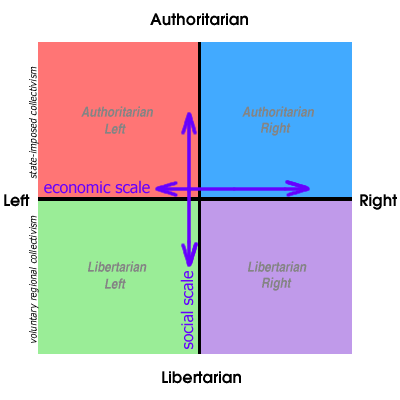
There have been attempts to build more complex models such as the Political Compass, which has two dimensions with an economic and a social scale, as shown below.


This matrix allows a more detailed representation of political views but in my view it still does not provide an completely accurate picture. For example, it puts Hitler at the very top of the social scale but in the middle of the economic scale, and Stalin on very left of the economic scale, whereas I see their Fascist and Communist philosophies as very similar in every respect. It is one of the great myths about Fascism that it allowed economic freedom. In Nazi Germany and Mussolini's Italy, private companies were permitted to operate only under the strict control of the state and only then when they served the state's interests. Thus, many companies were forced to move production capacity to armaments manufacture rather than the products their owners would have preferred to produce. That is hardly economic freedom.

The chart below shows the positions of various historical figures.
So where do I fit on the matrix? Here is my position:


What about Donald Trump? The Political Compass website assessed the US presidential election candidates as follows:

Trump is quite far up the social axis towards authoritarianism, as is to be expected, but perhaps not as far to the left of the economic scale as I would have thought. This is probably due to a bias in the framing of the questions that equates crony capitalism with economic freedom, which is essentially the same problem that places Hitler in the middle of the economic axis, as noted above. The closest of the historical figures on the chart to Trump is Margaret Thatcher, although I think Thatcher was significantly more economically liberal (and perhaps more socially conservative) than Trump.

Trump is the man the left-wing loves to hate but in reality his policies have far more in common with the views of those who describe themselves as 'lefties' than they do with my philosophical beliefs. It is ironic that Trump's first significant executive order was to withdraw from the Trans-Pacific Partnership agreement, an action he completed as people were marching in protest against his election. Many of those who were protesting were undoubtedly the same people who had protested against the TPP. It is revealing that in the above chart Hillary Clinton is further to the right economically than Trump - again something many of her supporters would be surprised to see.

I think there is really only one axis when it comes to political beliefs - authoritarian vs. liberal - and anyone who claims they can be at one end of the axis on social matters and the other end on economic matters is deluding themselves. The economist Milton Friedman (whose views are shown in the second chart above) said that a country could have economic freedom without political freedom, but not the reverse. I disagree - freedom is freedom, and economic freedom without social or political freedom, or vice-versa, is contradictory and unsustainable - but that is probably a subject for another blog post.

Tuesday, October 15, 2013

Wellington voters choose economic decline

The New Zealand local body election results are in, and here in Wellington we now have a slew of Green Party councillors on the city and regional councils as well as our Green mayor re-elected.  This is not entirely surprising. Wellington is the capital and many of its workforce are public servants.  They tend to hold left-wing political views and unsurprising support more government in the lives of citizens, not less.  The Green Party is, like most similar political groups worldwide, hard-left on economic matters.

Wellington as an economic centre is dying.  Even our Prime Minister, John Key, a man you would think would be sensitive to making such criticism of his seat of government, recently said so.  Wellington's problems started in the 1980s with the decline of its manufacturing base due to the (much-needed) reforms of the Lange-Douglas Government including the removal of protectionist trade policies.  The trend was exacerbated with a significant migration of corporate head offices and supporting service businesses to Auckland.   

The economic decline of the capital was disguised throughout the term of the Clark Labour Government in the 2000s because of the vast expansion of the public service with core employees increasing by about 40%. The majority of the increase was in Wellington and the spending of these public sector employees in the region drove up economic activity (and most notably property prices) during the nine years Labour was in power.  The Key National Government has stopped the expansion by limiting departmental budget increases and has even required some retrenchment of numbers.  This has meant Wellington's non-public-sector decline cannot be disguised any longer.

The Greens' policies, which are about socialistic redistribution of wealth and increasing compliance costs for development in pursuit of their environment agenda, are not likely to help matters.  Wellington can't afford the profligate, anti-growth economic policies of the Greens.  The city needs new businesses to generate employment and wealth to stem the decline of the past three decades.  The Greens offer only offer more economic blood-letting at a time when the patient needs vitamins.

If you want an example of what can happen at a local level after years of ill-advised policies you only need look at Detroit - a city that, like Wellington, once had the highest per capita income of any in the country, which has now filed for bankruptcy.  If Wellington is to avoid becoming another Detroit, its voters are going to have to choose politicians who value economic growth over fanciful socialist and environmental aims. Unfortunately I hold out little prospect of the capital's large public employee electorate making such a choice.