Showing posts with label zero carbon. Show all posts

Friday, July 16, 2021

The wishful thinking driving NZ's energy policy

This week the media and political classes were aghast at the revelation that New Zealand was importing record quantities of coal to fuel the Huntly Power Station. More than half of New Zealand's electricity is generated by hydro stations and recently the country has experienced less rainfall resulting in lower storage lake levels. Huntly is New Zealand's only large coal-fired power station and as such provides the perfect backup generating capacity, being able to be cranked up at short notice when other sources fail to meet demand. But instead of thanking the foresight of earlier energy planners for building a power station that could be used as a giant backup generator - providing the electricity that literally keeps people alive in the middle of a very cold winter - we have the usual whingers treating this blessing as a curse.

New Zealand is being set up for a serious fall in its energy policy. The Ardern Government has banned offshore oil and gas exploration, eliminating the best prospect for an independent energy future, and at the same time is pursuing a policy of being "Net Carbon Zero" by 2050. The radical Climate Change Commission, appointed by the Ardern Government, wants to go one better and eliminate the use of fossil fuels in all transport, manufacturing and other important economic sectors by 2035. The Government has already started to implement the Commission's recommendations by announcing special taxes on fossil-fuelled vehicles and subsidies on electric cars.

This is all delusional. The increased use of the Huntly Power Station shows that we do not have sufficient so-called renewable sources of electricity generation to meet current demand, let alone adding everything that presently drives our economy using fossil-fuels. Factories, farms, schools, hospitals and transportation all run mostly on petrol, diesel, natural gas and coal.

A modern internal combustion engine car can fill up with 50 litres of gasoline in a couple of minutes, and drive all the way from Auckland to Wellington, a distance of 650km, without stopping. The best electric cars today take up to 12 hours to fully charge and even if you believe the manufacturers' most optimistic claims about range, they will need to charged at least once more during the journey. The batteries add about half a tonne to the weight of the vehicle (compared to 40kg for that tank of gasoline), so you are using a considerable amount of the energy consumed just to carry the battery with you. And all that electrical power has to be generated somehow. Currently in New Zealand, as we have seen, the additional generating capacity can only come from imported coal.

There is a reason the world is powered mostly by fossil fuels and that is their incredible energy density. Petrol contains more kinetic energy than the equivalent weight of TNT, and a litre of petrol has more than a litre of hydrogen. That can of gasoline you fill up to power your lawnmower is still the most practical, portable source of energy ever developed. The best battery technology is at least two orders of magnitude worse in terms of energy storage. The only superior energy source in this respect is nuclear.

The Energy Minister, Megan Woods, talked about something called the New Zealand Battery Project, as if it would be the solution to all our future energy needs. This isn't actually an engineering project, as the name suggests, but a committee of eight people that "will evaluate the viability of pumped hydro schemes of various sizes". The committee comprises one electricity industry and one construction industry expert, with the remaining members being academics, environmental activists, local government bureaucrats and the requisite representative from a Maori tribe. Their only consideration of anything real is a speculative idea to build a pumped hydro storage scheme at Lake Onslow in the South Island, this in a country that hasn't built a large hydro power station since the Clyde Dam was commissioned in 1993.

If this Government is serious about becoming Carbon Zero, we need to start building power stations at rate never seen before in this country. We need dozens of new generation plants, not just a pie-in-the-sky hydro storage scheme. Ideally, these new plants would be nuclear-powered. The Chinese and Russians are the leaders in modular, safe, latest-generation nuclear power generation and we should be looking to invest billions of dollars in their technology. This is what the Government would do if it was serious about New Zealand being Net Carbon Zero. But the Ardern Government is no more serious about this that than they were about building 100,000 new houses.

Wednesday, April 22, 2020

Covid-19 is a dry run for climate change lockdown

If you were wondering what the impact of climate change policies such as New Zealand's Zero Carbon Bill will have on the economy, the Covid-19 lockdown provides the perfect prototype. The Government's own estimates stated that passing the Zero Carbon Bill would reduce this country's GDP by up to 22% by 2050 ceteris paribus (e.g. see this document [PDF]), and the OECD recently estimated that the Covid-19 lockdown would reduce our GDP by around 30%, so the two events are roughly comparable in ultimate impact.

This comparison is not an idle one. Policy makers are already talking about using the Covid-19 lockdown as a prototype for zero carbon policies. The UN's Paris Accord organisation sees it as an “opportunity to...relaunch economies on low-emission, climate-resilient trajectories”. The UK's Climate Assembly sees it as a "test run" for the for potential climate change shifts they have been proposing. According to assembly representative Ibrahim Wali, the UK could achieve its zero carbon target if “people could stay home more, work remotely. Sometimes in life you just need a challenge to change the way you live and operate." In other words, we could save the world from climate change if we could just make the lockdown permanent. In France, the citizens' assembly set up by President Macron has similarly proposed closing down hypermarkets, prohibiting the sale of almost all existing cars and even banning advertising for consumer products (you would think the French in particular would be wary of citizens' assemblies, but apparently not).

They are right in the sense that the Covid-19 lockdowns closely model the impact of zero carbon policies. If you imagine that zero carbon policies mean you're just going to swap your car for a Tesla and that will be it, then you are mistaken. You will be much poorer, just as those who have already lost their jobs and businesses from the Covid-19 lockdowns are today. You won't have a private car. You won't be able to buy all of the food you currently consume and you certainly won't be dining out much. You won't be able to keep your house warm in the winter or cool in the summer. You won't have access to many of the drugs and medical treatment you may need to stay alive. And forget about being able to travel overseas - that privilege will only be for the ruling elite. So get used to it people, if you're in one of the many countries that have legislated for zero carbon you're going to be in permanent lockdown.

On the positive side, the much more immediate threat of Covid-19 has stymied efforts to create a new world order based on carbon zero policies. It also provides the opportunity for some real world climate change experiments - for example, the reduced air pollution may allow scientists to better understand the impact of atmospheric aerosols on climate change. In an even more interesting development, the lockdown may enable scientists to test one of the central hypotheses of anthropogenic global warming - that mankind's carbon emissions are responsible for almost all of the increase in atmospheric CO2 since pre-industrial times. If the hypothesis is true, the reduction in fossil fuel emissions during the lockdown should result in a corresponding reduction in the rate of increase in atmospheric CO2. Climate scientist Dr Roy Spencer is examining this impact in the atmospheric carbon levels recorded at the Mauna Loa observatory in Hawaii. If there is no corresponding flattening of the CO2 curve, then it follows that factors other than mankind's carbon emissions are significant drivers of the increase in atmospheric CO2. That would mean all our efforts and policies to reduce carbon emissions from fossil fuels will be for nought.

[Hat-tip: Breaking Views @NZCPR for many of the above links]

Tuesday, September 18, 2018

Yes, the climate changes

Nobody denies climate change. At least, I have never heard of anyone denying that the climate changes. The debate is about the extent to which the rise in average global temperatures is caused by human emissions of carbon dioxide from the burning of fossil fuels.

The best estimate of the extent of global warming since 1750 is around 1ºC (e.g. see this recent paper published by the American Meterological Society). However, global temperatures changed continuously before this period as the following graph of the Northern Hemisphere proxy temperature for the past 2,000 years data shows.

Paleoclimatic temperature data for the last 2,000 years
Source: https://www.ncdc.noaa.gov/global-warming/last-2000-years
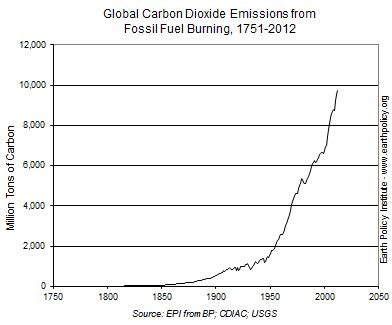
You can see that temperatures have increased markedly since around 1500 but a significant amount of that warming happened before 1900. If we look at mankind's CO2 emissions, they didn't start increasing significantly until the beginning of the 20th Century and didn't really take off until the 1950s.


The CO2 emissions curve traces a similar arc to the temperature line in red in the first graph but the increase in global temperatures started well before the rapid increase in the levels of human CO2. In fact, about half of the rise in temperatures predates the rise in CO2 from fossil fuels. So, how much of the global warming is manmade?

The United Nations Intergovernmental Panel on Climate Change (IPCC), in its 2013 fifth assessment report, states that it is “extremely likely that more than half of the observed increase in global average surface temperature” from 1951 to 2010 was caused by human activity. In other words, up to half of the increase was not due to human activity. This is the consensus of scientists - that mankind's carbon emissions are contributing to, but not wholly responsible for, an increase in global temperatures. It is also the consensus of most people on the so-called 'denier' side of the argument. 

So what to do about it? And should we do anything at all? Well, it depends on how much of a problem it is going to be. Looking at the first graph again, you can see that we are getting back to about the temperatures that prevailed around 1000AD - the Medieval Warm Period. There is no evidence, notwithstanding all the alarmist news reports about storms and heatwaves, that we have suffered any ill effects from the warming to date at all. We have had no increase in severe storms or heatwaves since 1950. For example, despite all the claims about the extreme weather in the United States recently, the following graphs from the National Oceanic and Atmospheric Administration (NOAA)'s Fourth National Climate Assessment show the frequency of cold spells, heat waves and the intensity of heat waves for the continental United States have mostly decreased since 1900.

Frequency of cold spells and heat waves and magnitude of
heat waves in continental USA since 1900

If you do your own research for almost any part of the world you see the same thing - no increase in severe weather events anywhere (e.g. see this blog post for the figures of tropical cyclones in the South Pacific). If human carbon emissions are causing the climate to go seriously awry, then we aren't seeing much evidence of it. The same is true of the human toll of climate change. This study of deaths from extreme weather [PDF], published in the Journal of American Physicians and Surgeons, includes the following graph that shows we have a small fraction of the deaths in relative and absolute terms now compared to earlier decades.

Global Death and Death Rates Due to Extreme Weather Events, 1900–2008
Scientists agree that a doubling of atmospheric CO2, all things being equal, would produce global warming of about 1ºC (see, for example, this paper, which states 'Without any feedbacks, a doubling of CO2...would result in 1°C global warming, which is easy to calculate and is undisputed.'). Some scientists believe that the temperature increase will be as much as 6° or 7° but these estimates are dependent on entirely speculative feedback mechanisms and are not widely accepted in the scientific community. There is little dispute that a small amount of additional 'forcing' of global temperatures will result from feedback mechanisms. Climate scientists Nicholas Lewis and Judith Curry (for whom I have a great deal of respect) estimate the overall increase at 1.64°C. Given the rate of increase of CO2 is around 2ppm per year and we have around 400ppm currently, it will take 200 years to produce this global temperature increase assuming we do not reduce our carbon emissions from current levels at all.

Of course, all that doesn't mean there are no serious effects of pumping billions of tons of carbon dioxide into the atmosphere year after year, but it also doesn't mean we have to abandon global capitalism because we face imminent doom, as so many climate change activists advocate. Indeed, to do so would be great folly because it is capitalism that provides the technological innovation we need to move to less dependence on the fossil fuels that enable us to live longer and better lives than ever before.

The challenges are of physics and economics. We use petroleum because it is the most efficient and accessible store of energy we have discovered. Companies like Tesla are pushing the curve in terms of battery life, charge time and weight, but we still have a long way to go before we can refill our car in a minute and drive 1,000 kilometres without stopping. Once the technology is cheap and ubiquitous, we won't need government regulations and carbon taxes to get us into electric cars.

The United States leads the world in reducing carbon dioxide emissions from fossil fuels. It has done so by moving to fracked natural gas for power generation and in agricultural and industrial production. Natural gas produces less than half the carbon dioxide of coal and two-thirds that of diesel oil. The development of fracking has been a wholly private-sector-led change that was done in spite the efforts of the Obama administration and many state governments to thwart it. Trump has sensibly reversed these policies and fracking has continued to grow to the point where America is now the largest producer of oil and gas in the world.

New Zealand's coalition government is determined to turn this country into a 'zero carbon' nation by 2050. The effects of this, as I have previously posted, will be to reduce our GDP by up to 22%. New Zealand produces around 0.1% of global CO2 emissions, so nothing we will do will have any direct impact on global warming. It is purely virtue signalling and unfortunately it will have huge impact on the quality of life in this country, all to fix a problem that the evidence shows to be not particularly serious.