Showing posts with label IPCC. Show all posts

Tuesday, September 18, 2018

Yes, the climate changes

Nobody denies climate change. At least, I have never heard of anyone denying that the climate changes. The debate is about the extent to which the rise in average global temperatures is caused by human emissions of carbon dioxide from the burning of fossil fuels.

The best estimate of the extent of global warming since 1750 is around 1ºC (e.g. see this recent paper published by the American Meterological Society). However, global temperatures changed continuously before this period as the following graph of the Northern Hemisphere proxy temperature for the past 2,000 years data shows.

Paleoclimatic temperature data for the last 2,000 years
Source: https://www.ncdc.noaa.gov/global-warming/last-2000-years
You can see that temperatures have increased markedly since around 1500 but a significant amount of that warming happened before 1900. If we look at mankind's CO2 emissions, they didn't start increasing significantly until the beginning of the 20th Century and didn't really take off until the 1950s.
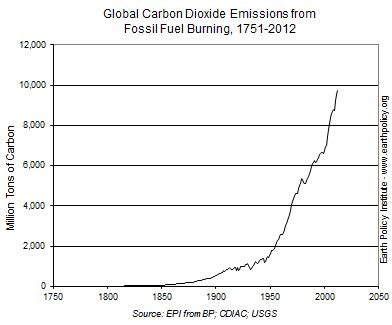

The CO2 emissions curve traces a similar arc to the temperature line in red in the first graph but the increase in global temperatures started well before the rapid increase in the levels of human CO2. In fact, about half of the rise in temperatures predates the rise in CO2 from fossil fuels. So, how much of the global warming is manmade?

The United Nations Intergovernmental Panel on Climate Change (IPCC), in its 2013 fifth assessment report, states that it is “extremely likely that more than half of the observed increase in global average surface temperature” from 1951 to 2010 was caused by human activity. In other words, up to half of the increase was not due to human activity. This is the consensus of scientists - that mankind's carbon emissions are contributing to, but not wholly responsible for, an increase in global temperatures. It is also the consensus of most people on the so-called 'denier' side of the argument. 

So what to do about it? And should we do anything at all? Well, it depends on how much of a problem it is going to be. Looking at the first graph again, you can see that we are getting back to about the temperatures that prevailed around 1000AD - the Medieval Warm Period. There is no evidence, notwithstanding all the alarmist news reports about storms and heatwaves, that we have suffered any ill effects from the warming to date at all. We have had no increase in severe storms or heatwaves since 1950. For example, despite all the claims about the extreme weather in the United States recently, the following graphs from the National Oceanic and Atmospheric Administration (NOAA)'s Fourth National Climate Assessment show the frequency of cold spells, heat waves and the intensity of heat waves for the continental United States have mostly decreased since 1900.

Frequency of cold spells and heat waves and magnitude of
heat waves in continental USA since 1900

If you do your own research for almost any part of the world you see the same thing - no increase in severe weather events anywhere (e.g. see this blog post for the figures of tropical cyclones in the South Pacific). If human carbon emissions are causing the climate to go seriously awry, then we aren't seeing much evidence of it. The same is true of the human toll of climate change. This study of deaths from extreme weather [PDF], published in the Journal of American Physicians and Surgeons, includes the following graph that shows we have a small fraction of the deaths in relative and absolute terms now compared to earlier decades.

Global Death and Death Rates Due to Extreme Weather Events, 1900–2008
Scientists agree that a doubling of atmospheric CO2, all things being equal, would produce global warming of about 1ºC (see, for example, this paper, which states 'Without any feedbacks, a doubling of CO2...would result in 1°C global warming, which is easy to calculate and is undisputed.'). Some scientists believe that the temperature increase will be as much as 6° or 7° but these estimates are dependent on entirely speculative feedback mechanisms and are not widely accepted in the scientific community. There is little dispute that a small amount of additional 'forcing' of global temperatures will result from feedback mechanisms. Climate scientists Nicholas Lewis and Judith Curry (for whom I have a great deal of respect) estimate the overall increase at 1.64°C. Given the rate of increase of CO2 is around 2ppm per year and we have around 400ppm currently, it will take 200 years to produce this global temperature increase assuming we do not reduce our carbon emissions from current levels at all.

Of course, all that doesn't mean there are no serious effects of pumping billions of tons of carbon dioxide into the atmosphere year after year, but it also doesn't mean we have to abandon global capitalism because we face imminent doom, as so many climate change activists advocate. Indeed, to do so would be great folly because it is capitalism that provides the technological innovation we need to move to less dependence on the fossil fuels that enable us to live longer and better lives than ever before.

The challenges are of physics and economics. We use petroleum because it is the most efficient and accessible store of energy we have discovered. Companies like Tesla are pushing the curve in terms of battery life, charge time and weight, but we still have a long way to go before we can refill our car in a minute and drive 1,000 kilometres without stopping. Once the technology is cheap and ubiquitous, we won't need government regulations and carbon taxes to get us into electric cars.

The United States leads the world in reducing carbon dioxide emissions from fossil fuels. It has done so by moving to fracked natural gas for power generation and in agricultural and industrial production. Natural gas produces less than half the carbon dioxide of coal and two-thirds that of diesel oil. The development of fracking has been a wholly private-sector-led change that was done in spite the efforts of the Obama administration and many state governments to thwart it. Trump has sensibly reversed these policies and fracking has continued to grow to the point where America is now the largest producer of oil and gas in the world.

New Zealand's coalition government is determined to turn this country into a 'zero carbon' nation by 2050. The effects of this, as I have previously posted, will be to reduce our GDP by up to 22%. New Zealand produces around 0.1% of global CO2 emissions, so nothing we will do will have any direct impact on global warming. It is purely virtue signalling and unfortunately it will have huge impact on the quality of life in this country, all to fix a problem that the evidence shows to be not particularly serious.

Wednesday, December 2, 2015

A Climate Change Primer

I don't write here much on the subject of climate change. This is in spite of the fact that I am keenly interested in the topic and it was climate change that really got me started blogging. The reason for my reluctance to return to the topic will be obvious to anyone who has been active in the public debate, but given the significance of the 21st Conference of Parties to the United Nations Framework Convention on Climate Change (COP21) being held in Paris, which has been hailed as the greatest gathering of world leaders in history, I thought it was time I returned to the subject and explained in layman's terms what all the fuss is about.

Around eight years ago I was talking to a friend of mine who is a prominent New Zealand scientist about the question of anthropogenic global warming and he urged me to read the 2007 Fourth Assessment Report (AR4) of the UN Intergovernmental Panel on Climate Change (IPCC), which had just been released.

At the time I was pretty neutral on the issue and I wanted to trust the authors of the report - after all, they were supposed to be experts in the field - but as I started to delve into AR4, I began to have some concerns about what I was reading. While I am not a scientist, I studied maths and statistics at university and climate science is more about these fields - analysing past trends and making predictions - than anything else. There is a bit of physics involved and this is entirely incontrovertible - Svante Arrhenius, a Swedish physicist, first suggested in 1896 that increases in atmospheric carbon dioxide (CO2) would lead to global temperature rises. The scientific disagreement (and there really is a lot of scientific disagreement - 97% consensus claims notwithstanding) is really in two areas - the extent to which increases in CO2 will drive a relative increase in global temperatures, and the extent to which carbon emissions from human activity are responsible for the CO2 increases. Let us deal with the second of these two issues first.

Carbon in the atmosphere is measured very accurately these days. The most reliable measurement is done by the Nasa Earth Observatory on the top of Mount Kilauea in Hawaii. It has been taking accurate measurements since the 1950s, during which period atmospheric carbon dioxide has increased from around 320 parts per million to around 400 ppm. Prior to this, the record is less accurate but other sources suggest the atmospheric carbon dioxide content increased from around 270ppm in the mid 19th Century, and some ice-core records suggest CO2 levels rose from as low as 220ppm in the 18th Century (which would indicate the trend started well before there were significant fossil-fuel emissions).

The scientific claim that humans are causing the increase is based on chemical analysis of the composition of the carbon in the atmosphere, specifically the change in the ratio between the quantity of the isotopes of Carbon-12 and Carbon-13. Biological sources such as trees contain more Carbon-12 so a measured decrease in the Carbon-13/Carbon-12 ratio in the atmosphere means the source of the emissions is likely to be biological. A major source of biological carbon emissions is, of course, the coal, oil and gas extracted from the ground and burned by humans, but there are also natural biological emissions from swamps, forest fires and the like. Further evidence that the increase is caused by humans is derived from the fact that the increase in atmospheric carbon dioxide in recent years roughly equates to the sum of human carbon emissions. 

It all seems perfectly logical to assume that mankind is causing the increase in carbon emissions until you consider that carbon in the atmosphere has never been constant and in fact there is strong evidence that atmospheric carbon dioxide levels rose to similar levels to today during earlier periods in the Holocene (up to around 12,000 years ago) and much higher than current levels in prehistoric eras. Some scientists have provided evidence that over long time periods increases and decreases in atmospheric CO2 tend to follow rather than lead corresponding changes in temperatures. Others have provided evidence that the changes in the C-13/C-12 ratio do not correlate with mankind's carbon emissions either geographically (i.e. the greatest increases are not over industrialised areas such as North America and Europe) or with seasonal cycles of human carbon output (e.g. increased fossil fuel use in cold climates during winter).

The other issue is whether anthropogenic carbon emissions will cause the sort of temperature increases that are predicted by some scientists and politicians. This depends on the effect of what physicists call 'forcing'. Scientists agree that increasing carbon dioxide in the atmosphere will not on its own produce an increase in temperatures anything close to the maximum level predicted in the AR4 report (6.6℃ by 2100). This predicted level of increase arises from computer models that multiply the warming effect of carbon dioxide by other factors, the most important of these being an increase in cloud cover. But the effect of increased cloud cover is known to be both positive and negative in terms of temperature increases. Water molecules in the upper atmosphere act as a greenhouse gas but clouds also reduce the amount of the sun's radiation reaching Earth thereby tending to reduce temperatures. Many scientists believe that increases in carbon dioxide will have a diminishing, not an increasing, impact on global temperatures.

The best indication of the likely future increase in temperatures is provided by the past increase. Average global temperatures have increased about 0.76℃ since the mid-19th Century - around 0.05℃ per decade. The rate of increase went up in the last few decades of the 20th Century to about 0.13℃ per decade but temperatures have been largely static since 1998. A reasonable worst case scenario is that the rate of increase in the late 20th Century will soon resume, which would mean we will see a 1℃ increase over the entire 21st Century. To put that in perspective, the total increase in temperatures from the Little Ice Age around the year 1600 to the present day is probably about 2℃. This period has seen the greatest increase in human life expectancy and quality of life in the history of our species, something that some historians ironically credit in part to the warmer climate.

Is this issue, as President Obama and the Pope are claiming, the greatest threat facing mankind? I certainly do not think so. Weapons of mass destruction, epidemic diseases, religious fundamentalism, even collisions with objects from outer space are probably greater threats to our civilisation. So why has this become the biggest issue of our time? Well, answering that question is probably another whole blog post.