In my last post (in which I correctly signalled that Theresa May would sell out her country by reneging on her promise to deliver Brexit), I wrote that I considered myself a political localist. It is interesting that this week The New Zealand Initiative and Local Government New Zealand (LGNZ) have launched something called the Localism project, which they claim is about 'bringing government back to the people'. It has some noble aims with which I agree - including 'devolution and decentralisation in the way New Zealand is run' - although I am sceptical about anything LGNZ advocates given its hypocritical plea to central government [PDF] to change the law so that it can override the rights of local electors to hold referenda on constitutional changes.
The NZ Initiative-LGNZ statement says that New Zealand has one of the most centralised governments in the world, with central government accounting for 88% of public expenditure compared with an OECD average of 46%. What they don't say is that New Zealand has one of the least complex government systems in the world with just two tiers - national and local - whereas most other countries have at least three, and in effect our central government also performs many of the roles of state governments in other countries.
The problem in New Zealand is the lack of constitutional separation and limitation of powers. We have only one house of parliament, having abolished our upper house in 1951, and being a Westminster-type democracy, our executive comprises the leaders of the ruling parties in parliament rather than being separately elected. Technically, it is our head of state, the Queen, who appoints the executive, but convention is that she always appoints those who command the confidence of parliament. The situation is made worse by the fact that in 1994 we voted to adopt the Mixed Member Proportional (MMP) electoral system, which means that half of our members of parliament are appointed by national political party leaders rather than selected by local electorate committees. In other words, MMP made Parliament more faceless and unaccountable.
I am sure you will see the true nature of the problem. The consequences of all of this is that we have a coalition government, the formal partners of which didn't even get a plurality of votes in the election. Our acting prime minister, Winston Peters, lost his own seat in parliament during the election and his party received a reduced share of the national vote. Furthermore, it is a government that is pursuing a fairly radical agenda and making decisions without bothering with the formality of parliamentary votes or even Cabinet decisions. A country in which a government that can do this is not a democracy by any commonly accepted definition. Left-wing New Zealanders support the new government because it is expanding welfare and the government's role in every area of the economy from housing to transport. But they should remember that a government that uses unfettered powers to implement policies they support can just as easily do it to implement policies they don't like.
The NZ Initiative-LGNZ Localism project is a nod in the right direction, but New Zealand's governance problems are more systemic than the demarcation of powers between central and local government. We need the checks and balances that come from a genuine separation of powers and we need to restore the local accountability of our national representatives that was lost when we implemented MMP.
Thursday, July 19, 2018

Thursday, July 12, 2018
Is Theresa May about to sell out her country?
It is all going wrong for those who supported Brexit. British Prime Minister Theresa May appears to be close to agreeing such a bad deal with the European Union that it has prompted her foreign minister, Boris Johnson, and Brexit minister, David Davis, to resign from Cabinet. It seemed a simple thing to do, for a sovereign nation like Britain to withdraw from an economic alliance, but the problems that have arisen prove that the EU has become by stealth something much more than an economic alliance. It is a supernational entity that has become so entangled in the laws and institutions of its members that withdrawing is like amputating a leg to remove a passenger from a crashed train.
I am pro-Brexit despite it probably being contrary to my personal interests. I am an Irish citizen who has lived in Britain for more time than in any other country except New Zealand, and it may well be that I will be unable to return to live in Britain in future. So why do I support Brexit?
I am certainly no nationalist. I have written before about how I believe that all nation states are artificial constructs, no matter how old or grand they are, and that there is nothing inherently good in one national structure versus another (although I don't think the same of political systems). I believe that smaller, more local government is generally better at protecting individual rights because it is easier to hold accountable than larger, more geographically spread government. I guess that makes me a localist - I like my politics grown locally in small holdings, like those who are localists in buying their food.
The European Union is a very big step on the road to a heterogeneous, global government, and that prospect scares the hell out of me. The type of society I would like to live in - a society that places maximum value on individual rights and freedoms and in which the government has strictly limited powers and is highly accountable to its citizens - is the very opposite of the European Union. There are so many layers of hierarchy between the people and their distant EU overlords in Brussels that it would put the Qing Dynasty to shame. There is no real representation or accountability, with all important policy decided by the unelected European Commission and its president Jean-Claude Juncker* rather than the show pony European Parliament. And that is exactly why the people of Britain voted to wrest back control of their country. Theresa May vowed to deliver the Brexit her people voted for, but I fear she has caught a dose of the Juncker hauteur and is about to sell out her own country.
* It is hardly surprising that Juncker has acted like an emperor who regards the Brexit vote as a personal slight on his majesty when you realise he has all the powers of an emperor. It is also revealing that when you click on the link to information about Juncker on the European Commission's website, you get the message "Access denied - You are not authorized to access this page." [UPDATE: The link has been fixed overnight - perhaps someone at the European Commission reads my blog!]
Tuesday, July 10, 2018
The courageous left comes out in support of free speech
I wasn't going to comment on the business of the mayor of Auckland banning visiting speakers Stefan Molyneux and Lauren Southern from using council venues, other than what I did on Twitter:

However, I've been surprised and immensely encouraged by the response in this country that is overwhelmingly in support of free speech, particularly from those on the left like bloggers Chris Trotter and IdiotSavant. I don't agree with their views that Molyneux and Southern are racists and Nazis, but perhaps that mistaken impression makes their support for the free speech rights of the two Canadians all the more impressive.
The left has been the traditional bastion of free speech, seeing it as an essential weapon in their war against entrenched privilege, but in recent years their newfound cultural relativism and identity politics has trumped all else and led many left-wingers to abandon their support for what is arguably the foundation of all individual rights. The change in the left's position is surely all the evidence anyone needs that it is the left, rather than the right, that is now the dominant political force in the West, because only those in entrenched positions of power would see the right to voice one's opinions as a threat.
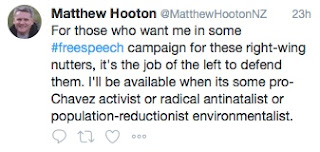
Then we have the views of certain people on the right wing who choose not to support free speech when it is two 'extreme' right-wingers who are being denied this right - people like this fellow:

Well, Mr Hooton, I don't buy it. It takes much greater courage to defend those beyond the pale on your own side than those opposed to you. You are obviously far too concerned with maintaining your carefully-cultivated 'reasonable right' position than standing up for the principles you claim to support.
A group of New Zealanders from across the political spectrum have established the Free Speech Coalition to challenge the Auckland mayor's decision in court. I would urge you to support them by donating on their website here.
Monday, July 9, 2018
Turning a Rock Star Economy into a Basketcase
In 1984, the newly-elected Labour Party Government saved New Zealand from becoming a third world economy. Prime Minister Robert Muldoon's Stalinist economic policies had resulted in high inflation, increasing unemployment, a run on the dollar. and the imminent failure of the country's largest bank. The new finance minister, Roger Douglas, devalued the dollar, deregulated the economy, sold off inefficient state assets, and the economy recovered to experience a period of sustained growth for the next three decades that was interrupted only by global economic downturns. Roger Douglas's liberal economic policies continued with remarkable consensus under successive governments but now the Labour-New Zealand First coalition government seems determined to undo all of its predecessors' good work.
New Zealand was acclaimed as a 'rock star economy' after the 2007 Global Financial Crisis because of its resilience in the face of rising debt and sluggish growth in the rest of the world, but as economist Michael Reddell points out (here and here), our economy hasn't really been performing that well since the mid-2000s.
So what is the new government doing that risks our economic performance? The answer is almost everything. It has banned oil and gas exploration at a time when other countries such as the United States and Britain are freeing up regulations and encouraging investment in new fossil fuel extraction technologies like fracking. It has introduced new petrol taxes, which will raise the price of everything that has a transport cost, and it is about to introduce its Zero Carbon Act, which (as Michael Reddell points out here) will reduce our GDP by between 10% and 22% by 2050.
The government is choosing to pick winners with its cronyism Provincial Growth Fund, which is based on the mistaken belief that taxing people and businesses so that the government can dole out money to other businesses is good economics. It is increasing welfare payments across the board and eliminating incentives for beneficiaries to get back into work. It is raising the minimum wage to one of the highest in the Western world and it is pushing 'fair pay' - forcing employers to pay workers more than their market value - which of course will reduce demand for labour, thereby increasing unemployment (because, in reality, the minimum wage is always zero). The government is also reviewing tax, through its Tax Working Group, and if New Zealanders don't believe the result will be to increase taxation across the board they are deluding themselves.
All of these policies will be a dead weight on our economy, dragging down its already non-rockstar performance while other countries continue to soar past us. The net effect will be to make New Zealand, and New Zealanders individually, poorer compared to the rest of the world. I have travelled all around the world and have seen the stark contrast between countries that have high GDP per capita and those at the other end of the scale. New Zealanders take their relatively high standard of living for granted and do not realise that prosperity is fragile. I don't want to live in a poor country but it seems that is where we are headed.
The truth of the rock star analogy has always been more Ozzy Osbourne than Taylor Swift, but if we continue down the path the new government is laying out, even the aging Black Sabbath rocker will look more lively than New Zealand's economic performance.
Saturday, June 30, 2018
SPLC learns that rights come with responsibilities
The Southern Poverty Law Centre (SPLC) has settled a defamation lawsuit brought by British 'liberal Muslim' Maajid Nawaz for $3.4 million. Nawaz is well known for his advocacy of human rights and moderate approach to dealing with Islamic extremism, so it was surprising when in 2014 the SPLC listed him and his Quilliam Foundation in their 'Field Guide to Anti-Muslim Extremists'. However, anyone who is familiar with the SPLC activities in recent years will know that the 50 year old organisation, which was established to fight the Ku Klux Klan and other white supremacist groups in the American South, has become an extremely partisan organisation itself. Any prominent political advocate who holds views that differ from SPLC's hard-left positions on a range of issues can expect to appear on one of its lists. That wouldn't be such a problem if it wasn't for the fact that many mainstream organisations use the SPLC's lists as the gauge of whether someone's political views are acceptable. Appearing on them is likely to result in you being banned from social media or even losing your job.
Many advocates of free speech (such as this writer in Quillette) have asked whether the settlement will have a chilling effect on freedom of expression. I think they are mistaken. No right is absolute. The right to free speech, such as is enshrined in the First Amendment to the U.S. Constitution, does not mean the right to be free of any costs of enjoying that right. This is probably the most misunderstood aspect of the nature of rights and this misunderstanding results in a distortion of the concept of rights. Rights are by definition universal, which means that my rights shouldn't abrogate your rights. It means that rights come with responsibilities. The right to life, for example, comes with the responsibility to provide for your own survival - it does not include the right to be fed.
In the case of defamation laws, there are two rights that are being balanced - your right to free speech with another person's right to pursue their own happiness. If you defame someone, you impose a cost on them - at the very least the intangible cost to their reputation but very often a real and tangible cost, such as on their ability to earn an income. The damages awarded in successful defamation suits do not abrogate your right to free speech but rather ensure you pay the costs of enjoying your right. The multi-million dollar award to Maajid Nawaz reinforces this important principle in law and won't have a chilling effect on free speech per se. The court didn't say SPLC couldn't continue to publish their Field Guide, only that it has a responsibility to get their facts rights and that there is a cost if they don't.
Monday, June 18, 2018
Bob Jones is doing us all a favour
Sir Robert Jones, the Wellington property investor, political pundit, boxing commentator and writer, has never been one to shy away from a fight. This time he is taking up his cudgel against a women who called him 'racist'. It all started with an opinion piece Jones wrote in his regular column in the weekly National Business Review newspaper about the annual Waitangi Day fiasco.
Waitangi Day is meant to be New Zealand's national day, celebrating the signing of the Treaty of Waitangi between Maori chiefs and the British Crown in 1840, but it has become a day of such insult and even violence from Maori activists that in recent years New Zealand prime ministers have refused to attend the ceremonies at Waitangi (where the Treaty was signed) and many New Zealanders refuse to acknowledge the day with anything more than contempt.
Bob Jones was making a satirical point in his column when he said that the day should be repurposed as 'Maori Gratitude Day', an occasion on which Maori give thanks to the British settlers for saving them from self-inflicted extinction. The woman Jones is suing raised a petition calling on the government to strip of his knighthood for his comments and managed to get 40,000 signatures, but it isn't the petition that is the subject of Jones's counterpunch but rather her libellous use of the 'racist' epithet.
I have recently written about the antonymic use of the term. It is used predominantly not to describe someone who wants to discriminate on the basis of race but rather those who object to such discrimination. Thus, if you believe we all should be equal under the law, you are called a racist. It is long overdue that such insulting and dishonest use of language was called out and those responsible be made to pay. If Bob Jones succeeds with his legal action, perhaps those who use the term with such profligacy for their own purposes will think twice.
Tuesday, June 5, 2018
Butchers, Bakers, Candlestick Makers and Gay Weddings
The United States Supreme Court has decided in favour of a Colorado baker, who refused to make a wedding cake for a gay couple, in what may be the first of a number of similar cases to go to America's highest court. The baker had challenged the decision of the Colorado human rights commission that ruled he did not have the right to refuse service on the basis of his religious beliefs.
I think the court made the right decision, despite saying in my last post that "we should judge others as individuals rather than as members of some identity group", because I believe the law shouldn't force anyone to act against their conscience. If a religious person thinks gay marriage is sinful and cannot reconcile the provision of products and services with their beliefs, then he or she shouldn't be forced to act against those beliefs. People are entitled to their prejudices and while I think such views are ignorant and irrational, I'll defend the person's right to have them.
The state should not discriminate because everyone should be equal under the law, but this does not mean the state should force private individuals and businesses to treat everyone equally. The idea of forcing a fundamentalist Christian, who takes the Biblical injunctions against homosexuality literally, to bake a cake to celebrate something he finds abhorrent, is itself abhorrent. Forcing someone to work against their will is slavery, pure and simple. If you disagree, I would you urge to apply the same principles to equivalent situations. Should we force Muslim butchers to sell pork? Or Catholic candlestick makers to sell candles to satanists?
The appropriate response to such prejudices in a free society is to discriminate against the people holding them. A boycott of those whose beliefs and actions you find contemptible is the best sanction. Business proprietors who limit their market to just those people who agree with their views are likely to find they have a far smaller market than businesses that are open to all. Likewise, someone who hires people only according to their prejudices will find they have a second-rate workforce. And for those gay couples who want a wedding cake, there is always another baker along the street who would be pleased to have their business.
The US Supreme Court decision makes it clear that it applied only to the specifics of the case before it and that it doesn't establish a general principle that businesses should be free to trade with whom they want. However, I think Justice Kennedy got it right when he summarised the thinking of the majority on the Court. "Tolerance is essential in a free society," he said, but he added that Colorado wasn't very tolerant of Phillips' religious beliefs when the state's human rights commission ruled against him. Indeed.
Subscribe to:
Posts (Atom)